
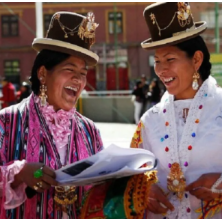
Baroque and Classical music from the New World, particularly from Latin America, has long fascinated me. Perhaps because it emerged under conditions in which colonial encounters and cultural exchanges brought together Indigenous, European and African traditions, or simply because it reminds me that beauty can emerge from the most unexpected and challenging circumstances.
What captivates me is not only the elegance of European musical styles and forms but also how they are subtly transformed and enriched by new rhythms, voices and textures that reflect diverse cultural influences. Listening to these works I feel wonder, admiration and surprise as they are familiar in their structure, yet strikingly original in spirit.
This is beautifully illustrated by the anonymous piece Stabat Mater Chiquitano: Ane Nupaquîma Suchetaña. Composed in the 18th century in Bolivia, in the Chiquitano language, this vocal work clearly exemplifies the way music intertwines Spanish sacred traditions with the vibrant rhythms and sounds of local cultures. It is in such works that the New World’s unique musical voice emerges most clearly: neither as a mere echo of Europe nor a complete departure from it, but as a vivid blend of traditions that continues to resonate with depth and originality to this day.
However, this musical fusion was not confined to the Chiquitano language. Throughout the New World sacred music often incorporated Indigenous languages as part of its devotional practice, reflecting both cultural adaptation and evangelisation. In Mexico villancicos were composed in Nahuatl as well as Spanish, blending European polyphony with local linguistic cadences. Similarly, in Paraguay the use of Guarani in choral music created a repertoire that spoke directly to the people, while remaining connected to the Catholic liturgical tradition. Also in Brazil, the Tupi language appeared in hymns, sacred songs and various polyphonic works.
Further along the Andean region, in Peru and Bolivia, Quechua found expression in hymns and processional songs, as exemplified by the Hanaq Pachap Kusikuynin (also known as Hanacpachap Cussicuinin). This anonymous Franciscan composition, dating from about 1620–1631, is regarded as the earliest known polyphonic vocal work printed in the New World. It appears at the end of Juan de Peréz Bocanegra’s Ritual Formularia, a liturgical manual in Quechua and Spanish with reference to Christian and Inca traditions. Performed on feast days and in religious processions as a hymn to the Virgin Mary, Hanaq Pachap Kusikuynin was written in the Spanish and Portuguese sacred Baroque style, yet it powerfully blends European liturgical traditions with strong Indigenous cultural elements.
In fact, much of the rich repertoire known today owes its existence to the work of religious orders such as the Jesuits, Franciscans and Dominicans, who used music as a tool for worship and evangelisation. These orders immersed themselves in native cultures, languages, beliefs and social structures, even creating dictionaries that helped understanding and preserve, to this day, many Indigenous languages.
Whether in local languages, Spanish, Portuguese or all of them together, vocal and instrumental music was carefully cultivated as part of daily life, particularly by the Jesuits, who taught Indigenous musicians to build instruments, perform and compose within European stylistic frameworks.
Their works were, however, far from mere imitations, their cultural expressions merged naturally with European forms, creating works profoundly shaped by local contexts and identities. This is well illustrated by Pastoreta Ychepe Flauta, an anonymous instrumental piece probably written in the early 18th century and preserved in the Archivo Musical de Chiquitos in Bolivia.
Fortunately, Latin American Baroque music continues to engage audiences and inspire musicians who perform these vibrant repertoires, ensuring they remain alive and resonant. Its legacy represents a living tradition and a meaningful message from its composers. Personally, these works have deepened my understanding of how Baroque and Classical musical styles and forms adapted and flourished outside Portugal and Spain, making me wonder how many other untold stories of creativity and resilience remain to be discovered.
By Anabela Pina