
Related program: Baroque and Before, Celebrating David Munrow and the Early Consort of London Friday 22 May at 8pm
By Robert Small
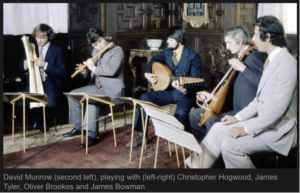
In May 2026 we commemorate the death of British musician David Munrow, who tragically took his own life 50 years ago, at 33.
The great achievement of Munrow’s short life was to bring the music of the Renaissance to a wider audience through the mass media of TV, radio, LP records and live performance. His charismatic personality made him a natural popular communicator who combined humour with deep scholarship and an obvious love of his subject.
His brilliance attracted the very best musicians to his cause, with Christopher Hogwood, Nigel North, James Bowman and David Thomas among the many great artists who worked with him and continued the early music revival after his death.
An extraordinary performer on early wind instruments, David’s natural skills were enhanced by a 12-month stay in Peru, during which he immersed himself in the practice of the local whistles and flutes.
Best known for his nimble recorder playing, he was also a dab hand at the curtal, rackett, crumhorn, shawm and bombarde, instruments he plucked from obscurity and placed in the mainstream of music with his double disc LP Instruments of the Middle Ages and Renaissance. No run-of-the-mill recording, Instruments was a declaration of arrival, with its striking cover featuring a painting of instruments and a lavishly illustrated book containing David’s amusing notes.
His catchy soundtrack for the hit TV series The Six Wives of Henry VIII, consisting of theme music and dances played by The Early Music Consort on original instruments, was undoubtedly one of the reasons for the show’s phenomenal success and has been credited with generating worldwide enthusiasm for the music and instruments of the Renaissance, dramatically increasing demand for the instruments and leading, incidentally, to the establishment of The Early Music Shop in the UK.
His colleague John Turner says of him:
The spur for such effervescent energy was a total wonder and enthusiasm for the music and the instruments on which it was played. If, consummate showman that he was, he did not hesitate to take liberties in presentation, he nonetheless always armed himself with the latest academic information on his chosen topic.
This melding of enthusiasm and knowledge led to Munrow’s ‘Pied Piper’ programmes on BBC radio, aimed at introducing children to music. His ‘scarcely credible output of 655 editions in around five years is one of the most preternaturally brilliant and prolific of any broadcaster in recorded history’, wrote Phil Hebblethwaite in a BBC tribute.
Munrow, who suffered from depression, took his own life in May 1976, possibly driven to despair by the recent deaths of his father and father-in-law (to whom he had dedicated Instruments of the Middle Ages and Renaissance).
His remarkable legacy continues into space, with one of his recordings launched in 1977 on the Voyager Spacecraft. A gold-plated copper record of Anthony Holborne’s ‘The Fairie Round’, from Paueans, Galliards, Almains and Other Short Aeirs was included in a compilation of sounds and images chosen as examples of the diversity of life and culture on Earth.