
From the Archives: This article appeared in the May 2020 issue of Fine Music Magazine
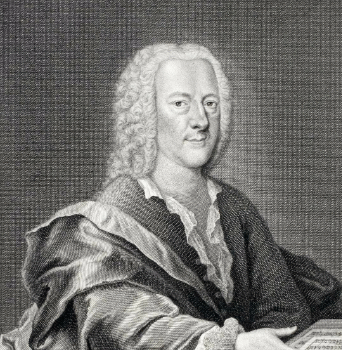
According to Handel, a lifelong friend, Telemann could ‘write a church piece of eight parts with the same expedition as another would write a letter’, an observation illustrating both his skill and his enthusiasm. Another writer recounted how Telemann wrote a whole cantata in less than 90 minutes to meet a performance deadline.
Many composers have pursued music despite opposition from parents and others; a prejudice seemingly especially pronounced during the Baroque era. Handel faced strong parental resistance, although these constraints served only to further inflame his passion, while Thomas Arne was so keen on music that he smuggled a spinet into his room and, damping the sound with his handkerchief, would secretly practise while the rest of the family slept.
The youngest of seven children, of whom only three survived, Georg Philipp Telemann was born at Magdeburg in 1681. His fascination with music came early; by age 12 he had already taught himself to play several instruments and had started to compose, although the only lessons he ever had were from an old-fashioned organist whom he quickly abandoned. The young Telemann, unlike Bach, already swore by everything new and modern.
Telemann’s father died when he was 13. As the boy’s gifts became more evident, vocal enemies of music came ‘in swarms’ to warn his mother against his pursuing it, pointing out that he ‘would become a travelling entertainer, tightrope walker, minstrel or squirrel master’ if he were to continue with it.
‘Said and done!’, wrote Telemann. ‘Music, instruments, and with them half my life were taken away from me. So I was sent to Zellerfeld in the Harz Mountains: perhaps my musical tyrants believed the witches would suffer no music behind the mountains!’
But his mother had misjudged things, for the Zellerfeld master to whom he was sent was versed in many fields including music and clearly rejoiced in his protégé’s gifts.
After he had spent four years there and another four at the Hildesheim Gymnasium Telemann’s mother tried again, insisting that he enrol at Leipzig University to study law. He recorded what happened next. He concealed his interest in music from everyone there until his roommate ‘accidentally’ discovered his score of a psalm and immediately arranged for it to be performed. The upshot was that Telemann was commissioned to set a new cantata for the Thomaskirche every fortnight. Things then moved so quickly that within a year he’d founded a student collegium musicum and become Musical Director of the Leipzig Opera.
Having abandoned the law, in 1705 Telemann left Leipzig for the court of the Count of Promnitz, travelling widely with him in Upper Silesia and Poland. During this time he developed an enduring interest in Polish rhythms and folk tunes. The following year saw him at Eisenach, until the death of his young bride caused him to move once again, this time to Frankfurt, where he was Director of Music for the whole city, marrying again and working untiringly. Finally, in 1721, he moved his family to Hamburg, where he remained until his death 46 years later. His position there was as town cantor, supervising the music of the Gymnasium. In addition to organising concerts, managing the opera and composing voluminously, it is likely that he spent most of his time as director of music in the city’s five principal churches.
A herculean worker throughout his entire life, he composed 3 600 items in every conceivable genre, both sacred and secular, making him probably the most fecund composer ever.
The term polygraph denotes, inter alia, an author who writes on a variety of subjects and, by extension, a composer who writes voluminously in one or more genres. Of that Telemann was guilty, causing a prominent 1770s critic, Christoph Daniel Eberling, to observe: ‘In general, he would have been greater had it not been so easy for him to write so unspeakably much: polygraphs seldom produce many masterpieces.’ This assertion, though, is demonstrably false: witness the many masterpieces of Bach, Handel and Vivaldi, not to mention Alessandro Scarlatti, Mozart and Schubert.
Universally revered during his lifetime, Telemann’s status after his death, like those of both Bach and Vivaldi, who also sank temporarily into obscurity, was quickly reduced to that of a grosse kleinmeister, literally, a large minor master. But as Will Yeoman, in an article in Limelight, observes: ‘It’s a universally acknowledged truth that the severe judgement of subsequent generations upon their forebears has little basis in logic or genuine discernment and is more to do with changing tastes.’
Nonetheless, so far did the pendulum swing against both Bach and Telemann’s vocal works that they came to be largely regarded, in the words of Steven Zohn, as ‘unnatural, unsingable, inappropriately dramatic and suffering from faulty text setting’.
Though Bach’s reputation recovered during the 19th century, Telemann’s works had to wait until the early 1900s to be recognised as those of a great and hardly less worthy master. His only sin, according to Yeoman, ‘is that he’s not Bach, Handel or Vivaldi, because his music is every bit as good as theirs!’
Related program: Diversions in Fine Music on demand (Monday 1 September at 9am)