
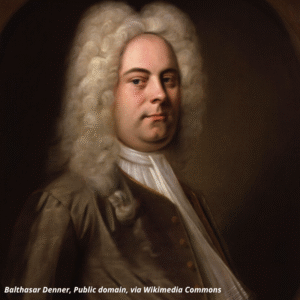
The death of Henry Purcell in 1695 at the tragically early age of 36 was a disaster for English music. The greatest talent of the English Baroque was gone, and English music was condemned to enter the 18th century led by mediocrities and hacks. The music-loving public could only look forward to occasional visits from a continental star to add a little glamour.
But salvation was at hand. In the minor provincial town of Halle, then a remote part of Brandenburg-Prussia, in 1685, a barber-surgeon called Handel had a son he named Georg Friedrich. From such an unlikely beginning fate was to produce the man whose career and legacy would dominate English music for the next 150 years and whose presence can still be felt today.
Handel’s father wanted him to become a lawyer, but his musical aptitude won out and his first job was as organist at the Calvinist church. Halle, however, was no place to build a musical career and, in 1703, aged 18, Handel left for Hamburg.
Even in the Protestant parts of Germany Italian opera was all the rage at this time and Handel soon produced three operas, all in the Italian style, which were modest successes. This encouraged him to try his luck in Italy.
He started in Florence, where his first Italian opera, Rinaldo, was produced. He then moved to Rome, Naples and Venice. It was in Rome, where opera was banned by papal decree as decadent, that he first encountered the oratorio. He wrote an oratorio (subsequently lost) which was performed at Easter 1708.
In 1710, with Italy in the grip of war, the Elector of Hanover offered Handel the position of Kapellmeister. Before taking up the position, however, he made his first visit to London. Italian opera was as fashionable there as it was on the Continent and Handel was able to stage Rinaldo again, with even greater success than in Italy. That success opened doors to London’s artistic establishment, as well as bringing him to the attention of potential patrons among the wealthy aristocracy.
Two years later, not surprisingly, Handel, who had already proved to be ambitious and a risk taker, decided to abandon his post in provincial Hanover and settle in London, where he also showed himself to be a shrewd businessman. He rapidly composed an Ode to honour Queen Anne’s birthday and then a Te Deum and Jubilate for performance at a service in St Paul’s to celebrate the Treaty of Utrecht, which ended the War of Spanish Succession. This earned him royal favour and a generous pension of £200 a year from the queen.
Handel was nearly undone, however, when Anne died in 1714, leaving as successor her distant cousin, none other than the Elector of Hanover whose court Handel had deserted two years earlier. George I froze Handel out for a while but in 1717 his Water Music, composed to accompany a royal promenade down the Thames, delighted the king and he was back in favour.
Aristocratic patronage followed this royal support, most prominently from the immensely rich Duke of Chandos, for whom the Chandos anthems were composed. The king and the duke also sponsored Handel’s own opera company, confusingly called ‘The Royal Academy of Music’. In the 1720s Handel was producing a new opera for the company on average every nine months.
His energy was extraordinary. In addition to 42 operas, odes, religious and ceremonial music, concerti grossi and organ concertos poured from his pen even as he ran an opera house company – a full-time job in itself.
By the late 1730s public tastes in opera were changing. Middle-class audiences wanted more dramatic content, and they wanted it sung in English. Handel had no wish to adapt his style, so gradually his opera composition petered out to be replaced by oratorios.
Remembering his earlier experience in Rome, and ever the entrepreneur, Handel came up with the idea of performing oratorios during Lent, when stage performances were forbidden. His first English oratorio, Athalia, premiered in Oxford in 1733. He wrote 24 in total, culminating with his supreme masterpiece, Messiah, in 1741.
Poor health and blindness restricted his output in his final years, but he died in 1759 a wealthy man. His status was confirmed by a funeral in Westminster Abbey attended by 3000 people.
Handel’s reputation and popularity grew after his death to the extent that music educators feared that musical development in England was being retarded by the focus on his work. Even 100 years after his death, on a visit to London in 1855, Richard Wagner observed: ‘Everyone holds a Handel vocal score as if it were a prayer book.’
Hear a selection of Handel’s music on The Life of a Composer at 8 pm on Saturday 19 July
David Brett