
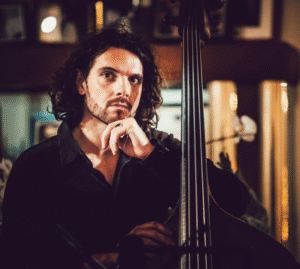
Maximilian Alduca is a double bassist who has made a significant impact on the Sydney jazz and experimental music scene. He has collaborated with some of Australia’s top jazz musicians, including Mike Nock, Paul Grabowsky and Dale Barlow. In addition to working with these renowned artists, Max is a key collaborator on various projects that have toured both locally and internationally. His recent performances include appearances at the Copenhagen Jazz Festival, the Wellington Jazz Festival, and the Manly Jazz Festival. He has just released his debut album, titled Monastery.
Barry O’Sullivan posed these five questions to him.
What were your earliest musical experiences and how did they influence your move towards a professional music career?
The earliest musical experience I remember was when I was in Year 3 or 4 at school during a band demonstration. While I can’t recall what the music sounded like, it was probably terrible! However, that didn’t matter; there was something about the collective sound that drew me in and captivated me. It was the power of music and its vibrations, which have the ability to transport us beyond the physical world in front of us. Family life wasn’t always perfect while I was growing up, so perhaps music also served as an escape for me. Since that experience music has consistently provided me with a path that has evolved into both a career and a sense of purpose in life.
You’ve just released your debut album, Monastery. Can you tell me why you chose that title and your inspiration for the music?
The album title came from the title track, ‘Monastery’, which was inspired by a 1 500-year-old monastery in the north of Portugal called Mosteiro de Sanfins. I was lucky enough to perform there with the Eishan Ensemble while on tour in 2022. The sound in the space was incredible and it inspired me to write a melody that I got a voice memo of at the time and later arranged for my quintet that perfectly communicated the sacredness and beauty of the space. It was the producer of the album, the amazing Lloyd Swanton, who suggested that that track be the album title. I think it fits perfectly as it hints at what’s inspired many of my compositions on the album – spirituality, interconnectedness, sacredness, trust and beauty.
You’re relaxing on a Sunday afternoon and wanting to chill, listening to some jazz music. What would your choices be and why?
That’s a hard one! So many great people and records to choose from. I’m going to go with something close to home and put on The Sea by Jonathan Zwartz. JZ is a big inspiration of mine and has been on my periphery since back in high school. I played in a band with his daughter, the amazing vocalist Martha Zwartz. The Sea is a beautiful album and perfect for a relaxing afternoon.
As a musician, you perform in a variety of ensemble situations. How do you adapt your strong personal visions to these situations?
I feel incredibly fortunate to play alongside the talented musicians I’ve met in Australia, and I truly enjoy the various musical contexts I find myself in. As I continue to develop my voice on the instrument, I’m finding it easier to embrace the role required in each musical setting while trusting that my unique voice will always shine through. Since I began composing and recording my own music I’ve noticed that it influences my overall musical expression beyond just the instrument, and this, in turn, enriches all the music I perform.
If you had not pursued a professional music life what would you have liked to have been?
Hmm, that’s a good question. I would probably lean towards a health worker, perhaps a counsellor or psychologist. I’ve often asked myself whether I’m really helping people with what I do. While being a musician may not directly save lives, it certainly acts as a healing force with the potential to change them.