
Barry O’Sullivan asked Paul five questions
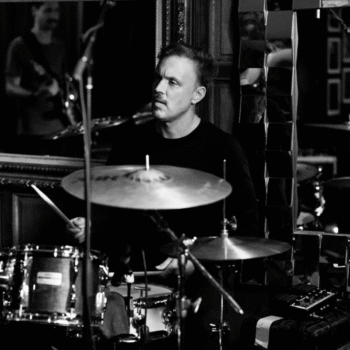
Paul Derricott is a Sydney-based drummer, composer and educator who is passionate about improvised, thematic music. He completed his studies at the Sydney Conservatorium of Music (BMus Jazz Performance). Technically exciting, while at ease in any improvisational situation, Paul is the leader of one of Australia’s most daring jazz acts, COAST, a band that has just released its third album, entitled Ember.
Do you remember when you first discovered jazz and what were the first tunes you came across?
Yes! It was No Aphrodisiac by the Whitlams. It has a great drum track which is an almost perfect example of texture and dynamics. Mike Richards, the drummer on Eternal NightCap was my drum teacher from early in my studies. A fantastic drummer and generous educator, I would ask him relentlessly about the music I had heard, and he would transcribe parts for me like ‘Mrs Baleen’ by Primus, Tony Williams on ESP, Andrew Gander on ‘A Night in Tunisia’ from the Mark Issacs album, For Sure.
The journey of music is a confluence of seemingly unrelated events, and if you are curious enough it will lead you somewhere. When I finally moved out of home Mum packed up some of my things, and among them I found a long-forgotten autograph book (a wild idea!).
In about year three of primary James Morrison brought his band to my public school. Certainly, seeing and hearing James and John Morrison, Steve Brien et al, was one of my earliest jazz experiences. That said, I was not a jazz kid at all, but I was a music kid. I have fond memories of concert band music under the guidance of Mike Butcher, school musicals and jazz bands at my high school (Castle Hill High) with Mike Williamson and Helen Lowry. It’s a long, winding journey for most musicians. I am in awe of the educators and touchstones that happened along the way.
Let’s talk about your compositions and your approach to new tunes. Can you describe the most essential ingredients you need?
I would quit music if I couldn’t compose. I have never been interested in playing other people’s complete drum parts. I have, for a long time, transcribed a lot of drums, but never to learn the song on the drums, just enough to get the idea or vibe of the thing, and then I am off. Although more and more I am completely interested in the song from a harmony and arrangement point of view. The drums are the fun part; the composition is the guts of the music. Composing for me is a practice, something I try and do regularly, but not necessarily with an outcome in mind. Essential to this is time and a vibe. What is a vibe? Maybe a kernel of an idea of what I am exploring. Sometimes that starts with the drums, but more often it begins with a melody or a part of one. I like to quickly give tunes a title, which also helps me to shape and ultimately finish them. Everyone should compose!
Tell us more about your new album, Ember, and the symbolism behind its title, your overall inspiration and your objective as an artist with this release.
Being of a place is important to me. I want music to sound of a place. My music ruminates on the places that I am in and the time I am in. ‘The Path and the River’ is about the multiple different speeds life can take. Sometimes you are the path and sometimes the river. I love listening to Sinatra singing ‘September in the Rain’: ‘The sun went out just like a dying ember’. It’s a beautiful lyric but a concept that I, in a personal main-character way, want to rail against. The album title, Ember, affirms continuing onward, burning intensely and being creative. I hate the idea of homogeneous art or monoculture. I like things to sound like they are of a place. The music in Sydney should sound different from the music of other places. My music is a part of that.
What are the highlights of your career so far, and where are you headed next?
I am very proud of this album and of COAST. Peter Koopman, Michael Avgenicos, Shannon Stitt and Dave Quinn all bring so much to the music. We have had a long relationship, and I hope it continues for many years. Recording these tracks and hearing them back is deeply satisfying. It is the most complete recording I have done. However, I don’t think of highlights generally. The tension and constant opportunity for the music to move my spirit is the repetitive highlight of being a musician. Some of my most treasured moments come from listening to music, playing music, learning music and even teaching music. It’s certainly satisfying playing big shows or with great artists, but often for me the most moving highlights sneak up when you least expect them: a performance at a small bar, or a song shared with my children. The performance credits aspect of it comes and goes with the tides.
Do you have any advice for younger musicians at the start of their careers or trying to make a name for themselves?
Listen: Documenting your music is a great thing. It is easy to not listen to yourself. Hear yourself.
Concept: Find something you are interested in, pursue it and follow your ears.
Focus: It’s a wild time to be creative. There is so much content. We can listen to all the music in the world. The weight of history can be too much. Don’t get distracted.
Think global, act local: Book a gig at your local venue and go to gigs at your local venue.
Crew: Find people you can make music with and do it as much as you can, and love musicians.