
David Edmonds
Part 6 – Operettas and Musicals
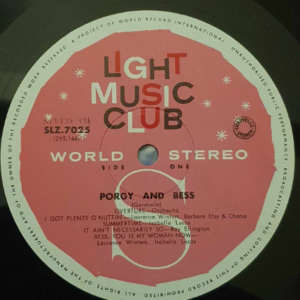
WRC offered a number of different genres in addition to classical music, among them operettas, musicals, jazz, vocals, music hall, Christmas music, world music and spoken word.
The Encyclopedia Britannica defines opera as a staged drama set to music in its entirety, made up of vocal pieces with instrumental accompaniment and usually with orchestral overtures and interludes. Operetta is defined as a musical-dramatic production similar in structure to a light opera but characteristically having a romantically sentimental plot interspersed with songs, orchestral music and rather elaborate dancing scenes, along with spoken dialogue. Its definition of musicals is theatrical productions that are characteristically sentimental and amusing in nature, with a simple but distinctive plot, and offering music, dancing and dialogue.
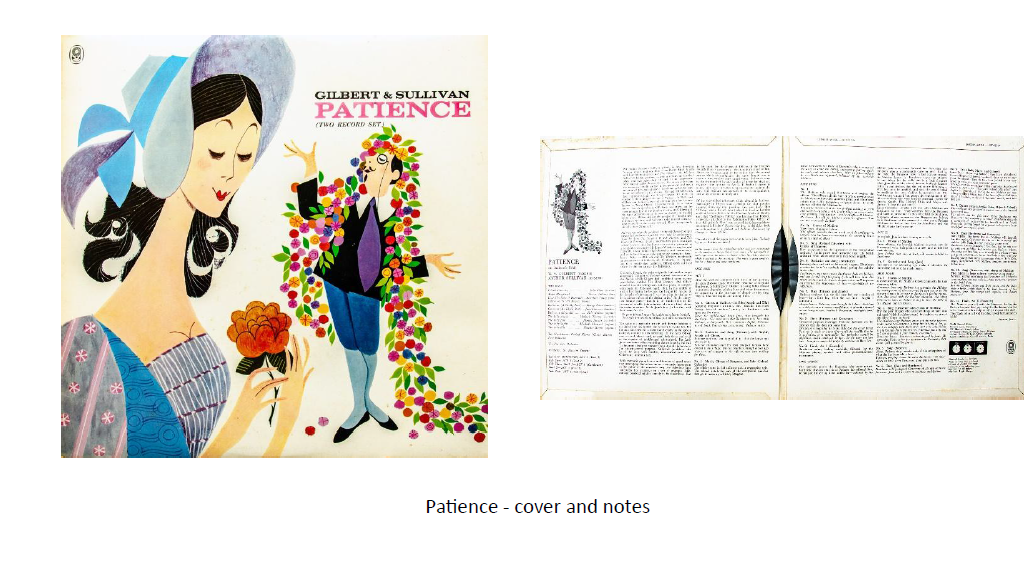
Importantly, in the mid-1960s WRC released some of Malcolm Sargent’s Gilbert and Sullivan recordings. The cast of Patience was a Who’s Who of British and Australian singers of the time – John Shaw, Alexander Young, George Baker, John Cameron, Elsie Morrison, Monica Sinclair, Elizabeth Harwood and Heather Harper, among others. Another early issue was The Mikado, with the Sadlers Wells Orchestra under Alexander Faris and a cast including John Wakefield and Marion Studholme
From its early days WRC offered lighter music, initially under its own label. It soon established a separate Light Music Club (LMC) label lasting to the end of 1962. An early 1960 LMC release was Lehar’s Merry Widow selections, in English, with Jacqueline Delman, John Larsen and John Wakefield in the leading roles with The Sinfonia of London under John Hollingsworth.
However, the major strength of LMC was numerous musicals, representing all decades and a multiplicity of composers, from Frederic Norton’s Chu Chin Chow, produced in 1916, through to Galt MacDermot’s Hair, in 1967.
Although not all are listed it is noticeable how many British musicals from the 1960s were issued by WRC, concurrent with their London stagings.
Both highly popular and more obscure (and now forgotten) musicals were released. Many were ‘one-hit wonders’ such as No, No, Nanette (‘Tea for Two’), Naughty Marietta (‘Tramp, Tramp, Tramp’) and Roberta (‘Smoke Gets in your Eyes’). They also included productions with music sourced from great composers such as Schubert (Lilac Time, c 1917), Borodin (Kismet, 1953), Greig (Song of Norway, 1944) and Johann Strauss II (The Great Waltz).
Undoubtedly copyright issues inhibited or prevented the production of some recordings, among them the works of Andrew Lloyd Webber. And Lerner and Loewe’s My Fair Lady was issued simply as a (wordless) orchestral suite.
Most LPs featured only one work but occasionally there were suitable couplings of two complementary musicals such as West Side Story/Guys and Dolls, Can Can/Paint Your Wagon, No, No, Nanette/Naughty Marietta and Gigi/Funny Face.
Most of the records were produced by a company called F.C.M., under the leadership of Cyril Ornadel. Regular artists included Marion Grimaldi, Barbara Elsy, Barbara Leigh, David Croft, Maggie Fitzgibbon, Stephanie Voss, Gordon Boyd, Barry Kent, Joyce Blair, Peter Hudson and John Larsen. Opera and concert singers included Jacquline Delman, Elizabeth Harwood, Thomas Round, John Wakefield, Ian Wallace and even Grace Bumbry as Carmen in Carmen Jones.
On occasions casts also featured stage and screen luminaries such as Diana Dors (Dr Doolittle), Barbara Windsor (Half a Sixpence), Ian Carmichael (Oliver), Alfred Drake (Kiss Me, Kate), Ray Ellington (Porgy and Bess), Sid James (Bye Bye Birdie), Laurence Harvey and Elizabeth Larner (Camelot) and Anthony Newley and Anna Quayle (Stop the World – I Want to Get Off).
Experienced conductors such as Kenneth Alwyn, Alexander Faris and John Hollingsworth also featured.
There were also Australian productions made and conducted by Geoff Harvey, including Maid of the Mountains/Balalaika, with Valda Bagnall and Neil Williams, and Rio Rita/Great Waltz, with Rosalind Keene and Neil Williams. Another Australian work was the 1961 JC Willamson production of The Sentimental Bloke by Albert Arlen, starring Edwin Ride.
Presentations
As with the Record Society, the Light Music Club (LMC) logo and label were not used throughout the lifetime of the WRC. On occasions the WRC logo and Light Music label did not match and releases reverted to WRC from late 1962. Eventually, for issues such as Hair, the labelling was that of the source company, RCA, with a simple WRC oversticker on the back cover.
The LMC covers were superbly photographed or designed, more relevant to the works than to the artists, although the early Merry Widow featured both. No expense appears to have been spared. The illustrations reflected their creators’ personal style. Later covers, such as that for Dr Doolittle, were simpler and not in full colour, but remained classy.
Hair, among the first works of a new generation of musicals was a suitable conclusion to WRC LP issues. Later Andrew Lloyd Webber works and frequently harder edged musicals such as Chicago, The Rocky Horror Picture Show and Cabaret coincided with start of the digital era and, a decade later, the replacement of CDs by LPs, at least for the following 30 years or so.
| Original recording production or label | Librettist/ Composer | Work | Artists | Logo and label | ||||
| HMV | Gilbert/Sullivan | Patience (1881) | Baker, Shaw, Young, Morrison, Pro Arte. Sargent | WRC | ||||
| HMV | Gilbert/Sullivan | Mikado (1885) | Wakefield, Studholme, Holmes, Sadlers Wells, Faris | WRC | ||||
| F.C.M. | Hassall*/Lehar | Merry Widow (1905) | Delman, Larsen, Wakefield, Sinfonia of London, Hollingsworth | LMC/WRC | ||||
| F.C.M | Asche/Norton | Chu Chin Chow (1916) | Alan. Grimaldi, Wakefield. Wallace, Sinfonia of London, Hollingsworth | LMC/LMC | ||||
| Geoff Harvey | Lonsdale/ Simson | Maid of the Mountains (1916) | Williams/Bagnall, orchestra, Harvey | WRC/LMC | ||||
| Maswitsz/ Posford & Brun | Balalaika (1936) | Williams/Bagnall, orchestra, Harvey | ||||||
| F.C.M. | Harbach, Hammerstein & Mandel/ Romberg | The Desert Song (1926) | Gwynne, Grant. Cliff Adams Singers, Richards | LMC/LMC | ||||
| * Librettist English Translation | ||||||||
| Original recording production or label | Librettist/ Composer | Work | Artists | Logo and label | ||||
| F.C.M | Hammerstein/ Kern | Showboat (1927) | Lawrence, Lucas, Linden Singers, Douglas | WRC/LMC | ||||
| F.C.M | Gilbert/ Benatzsky | White Horse Inn (1930) | Croft, Grimaldi, Leigh, Michael Sammes Singers, Douglas (in English) | LMC/WRC | ||||
| EMI Electro;a | Gilbert/ Benatzsky | White Horse Inn (1930) | Rothenberger, Minish, Munich Radio, Mattes (in German) | WRC/WRC | ||||
| F.C.M | Ira Gershwin/ George Gershwin | Porgy and Bess (1935) | Winters, Lucas, Ellington | LMC/LMC | ||||
| F.C.M | Hammerstein/ Rodgers | Carousel (1945) | Larner, Elsie, Kent, Orchestra, Douglas | LMC/LMC | ||||
| F.C.M | Berlin/Berlin | Annie Get Your Gun (1946) | Fitzgibbon, Boyd, Linden Singers, Douglas | WRC/LMC | ||||
| Capitol | Porter/Porter | Kiss Me Kate (1948) | Drake. Kirk, Howard Lang Orchestra, Davenport | WRC/WRC | ||||
| F.C.M | Hammerstein/ Rodgers | The King and I (1951) | Gwynne. Pastell, Orchestra, Douglas | LMC/LMC | ||||
| F.M.C | Lerner/ Loewe | Paint Your Wagon (1951) | Rumson, Larner, Peter Knight Singers | LMC/LMC | ||||
| Burrows/ Porter | Can Can (1953) | Pistache, Larner, Wallace Peter Knight Singers | ||||||
| F.C.M. | Stewart/ Strouse | Bye Bye Birdie (1960) | Blair, Gilmour, James Michael Sammes Singers | LMC/LMC | ||||
| F.C.M. | Bart/Bart | Oliver (1960) | Howell, Carmichael, Blair, Michael Sammes Singers, Alwyn | WRC/LMC | ||||
| F.C.M. | Loesser/Loesser | Guys and Dolls (1950) | Leigh, Boyd, Blair, Alwyn | WRC/LMC | ||||
| Sondheim/ Bernstein | West Side Story (1957) | Leigh, Hudson, Alwyn | ||||||
| F.M.C | Lerner/ Loewe | Paint Your Wagon (1951) | Rumson, Larner, Peter Knight Singers | LMC/LMC | ||||
| Original recording production or label | Librettist/ Composer | Work | Artists | Logo and label | ||||
| HMV | Hammerstein et al/Rodgers | Flower Drum Song (1958) | Shepley, Chang, Minami, Lowe | WRC/WRC | ||||
| Decca | Bricusse/ Newley | Stop the World • I Want to Get Off (1961) | Newley, Quayle, Orchestra, Fraser | WRC/WRC | ||||
| WRC UK | Heneker/ Heneker | Half a Sixpence (1963) | Windsor, Wilde, Mike Sammes Singers | WRC/WRC | ||||
| WRC UK | Bricusse/ Bricusse | Doctor Doolittle (movie 1967) | Kernan. Dors, Orchestra, Braden | WRC/WRC | ||||
| RCA | Ragni & Rado/ MacDermot | Hair (1967) | Curry, Dyson, Eason | RCA/WRC oversticker | ||||
Presentations
As with the Record Society, the Light Music Club (LMC) logo and label were not used throughout the period of the WRC. On occasions the WRC logo and Light Music label did not match and releases reverted to WRC from late 1962. Eventually, for issues such as Hair, the labelling was from the source company, RCA, with a simple WRC oversticker on the back cover.
The LMC covers were superbly photographed or designed, relevant to the work(s) than to the artists, though the early Merry Widow featured both. No expense appears to have been spared.
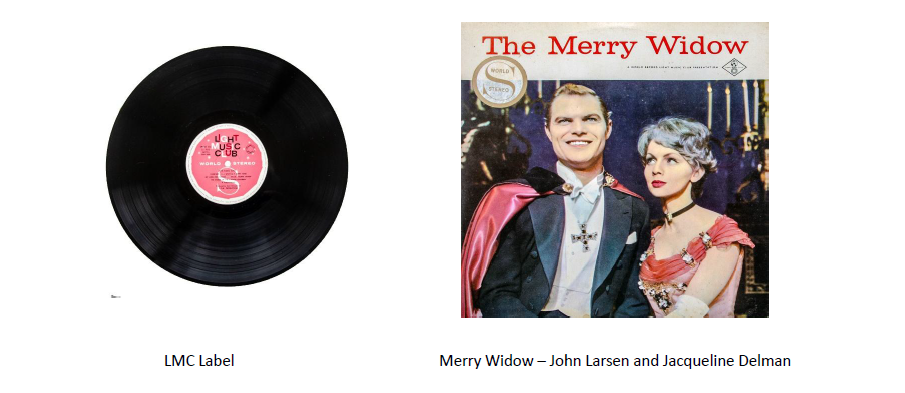
The 2 LP sets of G&S releases were all similarly designed, giving the opportunity for notes on two covers either issued as a folder or two separate LPs.
Chu Chin Chow was similarly extravagant, one LP but with a folding cover to give double note space
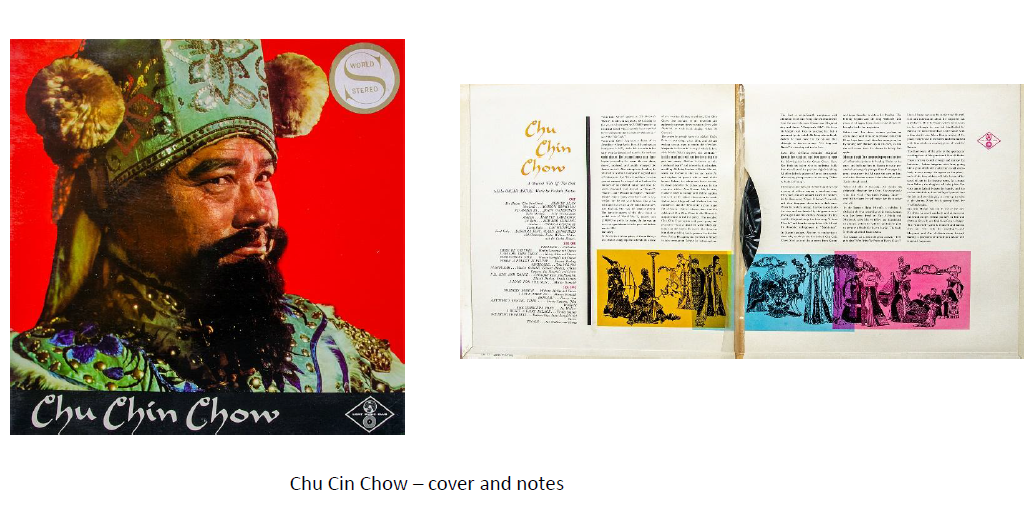
Covers and rear covers carried photos or design, relating to the content.
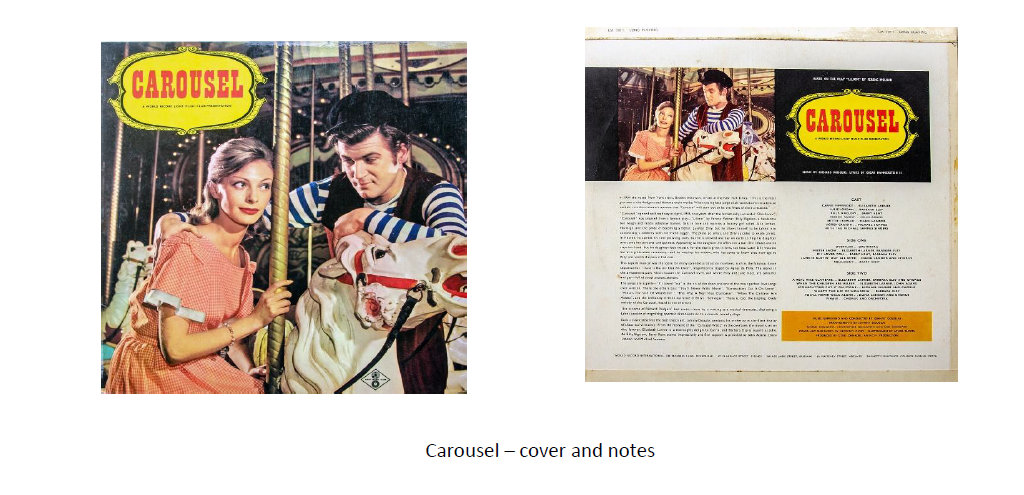
There were various cover illustrators with their own, always qualty, style.
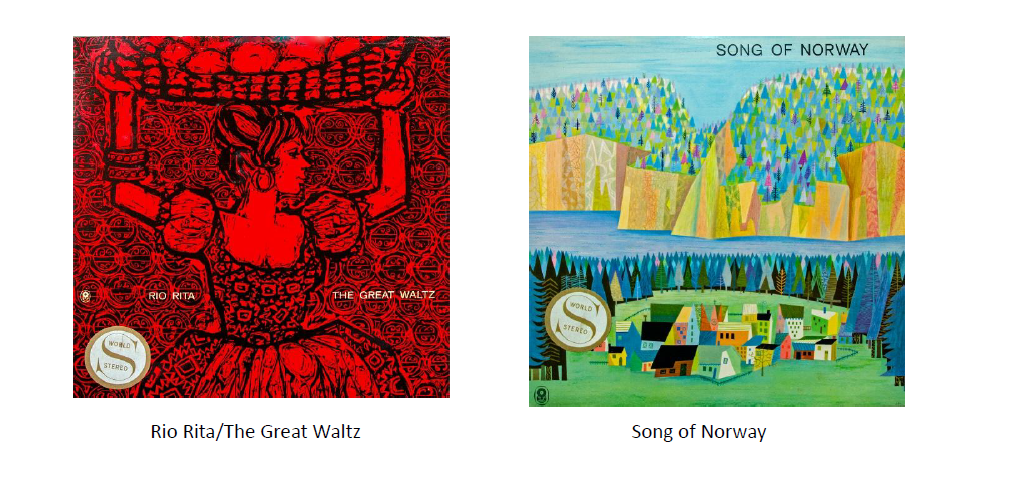
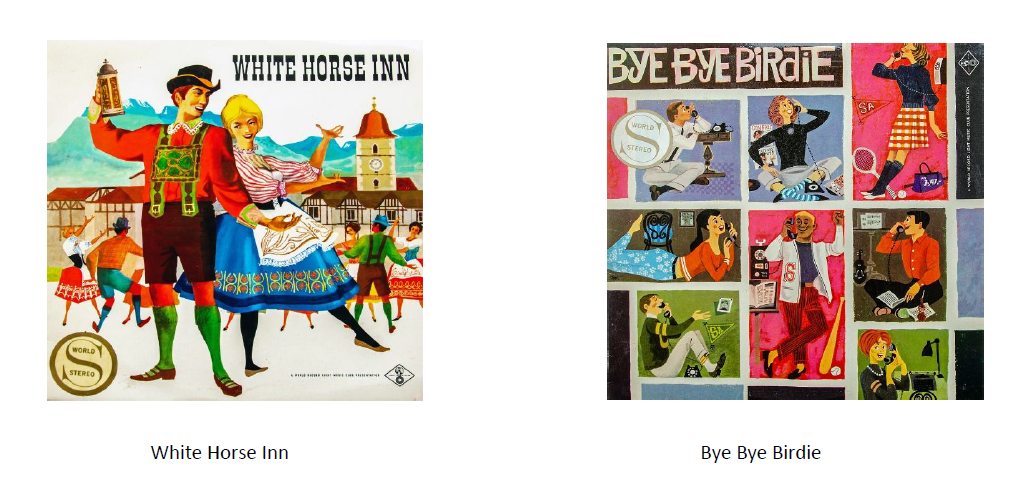
Later covers such as for Dr Doolittle were simpler and not in full colour but remained classy. However eventually, as described in the previous article, cover artwork was that of the originating label, as illustrated by the iconic Hair cover.
Hair was at the foreground of a new generation of musicals and so was fittingly a suitable conclusion to the LP issues. Later Andrew Lloyd Webber works and frequently harder edged musicals such as Chicago, Rocky Horror Show and Cabaret coincided with beginnings of the digital era and a decade after with replacement of LPs by CDs, at least temporarily.
References
Personal Collection
Discogs website
Read part one to five HERE