
By Dr Terry Reilly
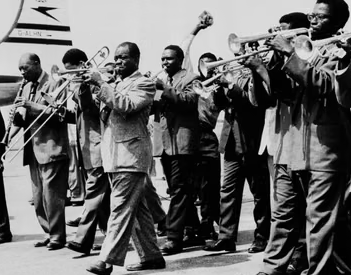
Jazz has the ability to take the hardest realities of life and put them into music, only to come out with some new hope or sense of triumph.
Martin Luther King Junior
The story of the relationship between jazz and the civil rights movement is as complex as the music itself, according to a 2MBS project looking at innovation in jazz.1
We have been reminded recently of the gargantuan struggle of the African American community for their freedom and rights of expression, and the part played by jazz musicians as witnesses to this struggle. First was the visit to Australia in February of Martin Luther King Junior’s son, Martin Luther King III and, in the same month, the death of the Reverend Jesse Jackson, a protégé and ally of King.
Throughout their decades of struggle Jackson and King were fortified by both their religion and their music. But they might have had a somewhat romantic view of the relationship between the civil rights movement and the music.
Unlike opera, jazz is not large scale, nor is it narrative based, and so is often limited in terms of its capacity to carry complex stories. Nor is it folk music, with declamatory texts and singable choruses. Folk musicians were more likely to stand on stage with civil rights leaders than were jazz musicians.
Civil rights
The civil rights movement was the organised resistance of African American and liberal white communities in the USA to racial discrimination and exploitation, largely in the southern states – a struggle that unfortunately continues to this day.
Occasionally public policy played a key role as various US governments, at regular intervals in the 1950s, 1960s and 1970s, legislated to remove discrimination in voting, housing, education and employment … but to little immediate effect, especially in the South.
Rather, it was the intensity of the resistance of the African American communities at the time that defined our understanding of civil rights. Its potency was reflected by a new player – the media. The highly visual struggle of a community with a ‘ready to go’ soundtrack based on the musical traditions of Africa and the Christian churches, was one of the first of its type to be recorded and distributed via print, radio and television.
Its ‘soundtrack’ bristled with speeches, legislation, troop mobilisations, lynchings, violent protests, police brutality, bombings of churches, burnings and assassinations.
The soundtrack
The civil rights movement of the 50s and 60s opened with a well-known soundtrack of church and folk songs offered by already famous artists – Staple Singers, Joan Baez, the Golden Gospel singers, Odetta.
By the 1950s there was declining interest and trust in the promise of civil rights legislation among the African American community. Among the jazz musicians, interest in the opportunities that might be brought by legislative reform had long given way to local efforts to stop white musicians from coming into black neighbourhoods and stealing innovations.
Very few jazz musicians were heavily involved in the movement, and this is reflected in the paucity of albums and titles drawing on the language of the cause, referencing events, or using the stage to advance civil rights.
There were exceptions. In the 1940s musicians like Charlie Parker and Dizzy Gillespie were involved in civil rights and progressive politics generally. Parker’s Now Is the Time recording in 1944 upset some record companies, as did Gillespie’s sponsoring of Latino liberation and music. Come the 60s it was Art Blakey, Charles Mingus, Archie Shepp and spiritual jazz giant Pharoah Sanders who were sufficiently audacious to speak out whenever race relations in the South boiled over. Blakey produced two albums, titled Free For All and The Freedom Rider, dedicated to those who had died in the struggle in the South.
The ‘jazz soundtrack’ for the movement was largely ‘straight-ahead’ jazz, with only a hint of Charlie Parker’s past radicalism and of John Coltrane’s coming storm. Only Blakey’s Freedom Rider, in which an entire track is a drum solo, deviated from the straight-ahead format and that gave the listener a hint of the turmoil of the times.
| YEAR | TRACK/ALBUM | ARTIST | INCIDENT |
| 1944 | Now is the time | Parker | Post-war expectations |
| 195// | Koko | Parker | Post-war expectations |
| 1959 | Mingus Fables of Faubus (without the spoken word) | Mingus | Alabama school segregation |
| 1959 | Free for all | Blakey | Freedom Riders Voting rights Assassination of workers |
| 1959 | 1959 Simone, with Mississippi Goddam | Simone | Birmingham bombings of a church by Klan killing four young girls. |
| 1963 | Alabama 63 | Coltrane | Birmingham bombings of a church by Klan killing four young girls. |
| 1964 | Freedom Riders Wonderful drum solo | Blakey | Freedom Riders Voting rights Assassination of workers |
| 1965 | Fire Music Spoken word elegy for Malcolm X | Malcolm X death | |
| 1968 | Why | Simone | MLK death |
| March on Selma | Grant greens | Selma, Montgomery marches | |
| March on Selma | Blue Mitchell | Selma, Montgomery marches | |
| 1969 | Power to the people | Joe Henderson | Civil rights |
| 1969 | Compared to what | Eddie Harris | MLK |
| Wake Up, Niggers | Last poets | MLK | |
| Compared to what | Roberta Flack | ||
| 1969 | Malcolm’s gone | Pharoah Sanders | Malcolm X |
| And resurgence of CR in operatic form | |||
| 1995 | Blood on the Tracks, which recounted musically the life of the plantation | Wynton Marsalis | |
| 2010 | Avant garde Shadows on the wall, a five-CD history of slavery | John Carter | |
| 2023 | We are on the edge | Art Ensemble of Chicago | |
Note: The recordings often came well after the events they referenced.
The outstanding artistic and political exception in these earlier years was Max Roach, whose album We insist, was both operatic and radical. It was a confronting piece, blending shrill avant garde vocals with African percussion and rhythms in a declamatory style. As a result, the musical style was never repeated for several decades until Wynton Marsalis’ 1995 Blood on the Tracks.
It was Nina Simone who, from the outset, constantly confronted the South publicly and called out the government. She had the recipe – celebrity, lyrics and the spoken word, catchy (strident) music and solid recording contracts. As a solo artist she was able to write and produce titles such as her Mississippi Goddam in response to events.
The real revolution
For the musicians, the real revolution took place in the practice rooms, studios, hotels, bars and clubs of newly formed urban communities.
The music became more important to most musicians individually and culturally than the civil rights movement. This was a period of great musical innovation and creativity. Most musicians had little time for other pursuits, trying an endless sequence of changes to the music that spewed from the likes of Parker, Ornette Coleman and Coltrane.
For the first time it looked as though the production of jazz music might become a stable industry. For the first time an economic and cultural asset was, at least partially, within the community’s control. For the jazz mainstream there was the Blue Note Label. For the more radical and innovative players there were smaller labels (often spinoffs from the majors) for support and the opportunity to play provocative music. At the new Impulse label Bob Thiele recorded some of Coltrane’s and Shep’s more radical music including respectively Alabama and Fire Music that were inspired by the civil rights struggle. At Atlantic it was Ahmet Ertegun with early Coltrane.
Civil rights or black power?
With the death of King, African American communities were to shift away from his church-driven tradition, musically and politically, towards the more radical Black Power movement, and from the previous generation of straight-ahead jazz towards electronic funk. Jazz musicians quickly adopted African names and dress and introduced the electric keyboard to the jazz stage. In the 70s Eddie Harris’/Roberta Flack’s song ‘Compared to What’ embraced the new sound and became an anthem for civil rights and the anti-Vietnam movements.
Summary themes
A civil rights movement requires a soundtrack that is empathetic but also understandable, with shared language and messages. But it must also carry grander and more timeless stories. Only Simone mastered this form of production, and it was she who was most effective in communicating the events of the movement widely and rapidly.
Most jazz musicians concentrated on the demands first of an increasingly innovative musical form in the 502 and then the commercial opportunities presented by growth of the music industry in the 60s and 70s.