
Here is an eclectic selection of jazz musicians born in March, prepared by Louise Levy and Phillip Cant.
Glenn Miller
March 1, 1904 – December 15, 1944

“We didn’t come here to set any fashions in music. We merely came to bring a much-needed touch of home to some lads who have been here a couple of years.”
Glenn Miller was an American big-band trombonist, arranger, composer, and bandleader in the swing era. He was the best-selling recording artist from 1939 to 1942, leading one of the best-known big bands. Miller’s recordings include “In the Mood”, “Moonlight Serenade”, “Pennsylvania 6-5000”, and “Little Brown Jug”. In just four years Glenn Miller scored 16 number-one records and 69 top ten hits—more than Elvis Presley and the Beatles did in their careers. While he was travelling to entertain U.S. troops in France during World War II, Miller’s aircraft disappeared in bad weather over the English Channel.
Ralph Towner
March 1, 1940 – January 18, 2026
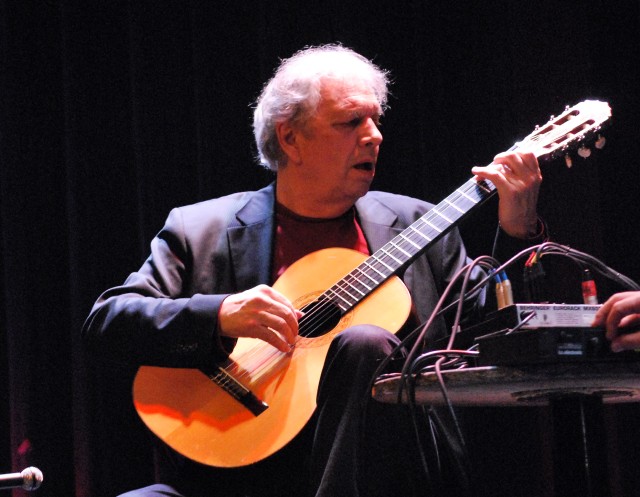
“The most exciting rhythms seem unexpected and complex, the most beautiful melodies simple and inevitable.”
Ralph Towner was an American multi-instrumentalist, composer, arranger, and bandleader. He played the twelve-string guitar, classical guitar, electric FRAME guitar, piano, synthesizer, percussion, trumpet, and French horn. Born into a musical family, he learned to improvise on the piano at the age of three. He began his career as a conservatory-trained classical pianist at the University of Oregon and was strongly influenced by the renowned jazz pianist Bill Evans. At the age of 22 he began improvising on classical and 12-string guitars, studying classical guitar at the Vienna Academy of Music with Karl Scheit. He preferred small groups of mostly acoustic instruments that emphasize dynamics and group interplay. He obtained a percussive effect from the guitar by weaving a matchbook among the strings at the neck of the instrument. Towner also made use of overdubbing, allowing him to play piano (or synthesizer) and guitar on the same track.
Eddie “LockJaw” Davis
March 2, 1922 – November 3, 1986

“In my case I wanted the instrument for what it represented. By watching musicians I saw that they drank, they smoked, they got all the broads and they didn’t get up early in the morning. That attracted me. My next move was to see who got the most attention, so it was between the tenor saxophonist and the drummer. The drums looked like too much work, so I said I’ll get one of those tenor saxophones. That’s the truth.”
Eddie Lockjaw Davis was one musician who provided a link from the big band era through to the soul-jazz phenomenon of the late 1950s and early 1960s. Davis developed one of the most unmistakable tenor sax sounds in post-war jazz. With a full-bodied yet reedy tone that was equally at home in rhythm & blues settings as more modern contexts, his playing always had a direct, singing quality that was a huge influence on the next generation of sax men.
Barney Bigard
March 3, 1906 – June 27, 1980
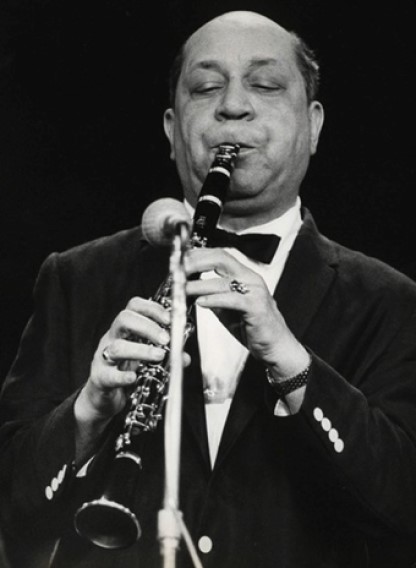
Albany Leon “Barney” Bigard was an American jazz clarinetist known for his 15-year tenure with Duke Ellington. He attended local schools and studied music and clarinet with Lorenzo Tio. In the early 1920s, he worked with King Oliver and others in Chicago. During this period, much of his recording, including with clarinetist Johnny Dodds, was on tenor saxophone, which he played often with great lyricism. In 1927 Bigard joined Duke Ellington’s orchestra in New York, playing with Ellington until 1942. He was the featured clarinet soloist, while also doing section work on tenor saxophone. After leaving Ellington’s orchestra, Bigard moved to Los Angeles, did soundtrack work for Hollywood film studios and had an onscreen featured role with an all-star band led by Louis Armstrong in the film New Orleans (1947). He began working with trombonist Kid Ory’s group during the late 1940s, and later worked with Armstrong’s touring band, the All Stars, and others. In 1951 Bigard appeared in The Strip with Armstrong, Jack Teagarden, and Earl “Fatha” Hines (all playing themselves). He again appeared and played in the movie St. Louis Blues (1958), with Nat King Cole, Ella Fitzgerald, Pearl Bailey and Eartha Kitt.
Miriam Makeba
March 4, 1932 – November 9, 2008

“When I was young, I never bought records because my brother Joseph played saxophone and had a record player. I loved listening to his records: The Dorsey Brothers, Duke Ellington, all the big American jazz bands, and vocalists like Ella Fitzgerald, Ernestine Anderson, and Kitty White, a singer from the US who was a friend of Nina Simone. Nobody in America seems to know about her, but she was quite popular in South Africa.”
“Nicknamed Mama Africa, Miriam Makeba was a South African singer, songwriter, actress, United Nations goodwill ambassador, and civil rights activist. Associated with musical genres including Afropop, jazz, and world music, she was an advocate against apartheid and white-minority government in South Africa.”
Ralph Peter Alessi
March 5, 1963

“On the tune ‘Fun Room’, Alessi played different improvisational trumpet voicings. “That song came about when I decided to use a slide in the studio to see what it would sound like,” he recalled. “I have to say that I stole that idea of using extended technique from Nate Wooley.”
Trumpeter/Composer Ralph Alessi was born in San Francisco, CA, the son of classical trumpeter Joe Alessi and opera singer Maria Leone. After taking degrees in jazz trumpet and bass—he studied under the legendary Charlie Haden at CalArts—he set out for New York, where he swiftly became a ubiquitous presence on the downtown scene. He’s been a frequent collaborator with such notable musicians as Steve Coleman, Jason Moran, Don Byron, Ravi Coltrane, Fred Hersch, Uri Caine and Marc Copland.
Wes Montgomery
March 6, 1925 – June 15, 1968

“Regardless of what you play, the biggest thing is keeping the feel going.“
Wes Montgomery was an American jazz guitarist. One of the most influential guitarists of the 20th century, Montgomery was known for an unusual technique of plucking the strings with the side of his thumb and his extensive use of octaves, which granted him a distinctive sound.
Lee Young
March 7, 1914 – July 31, 2008
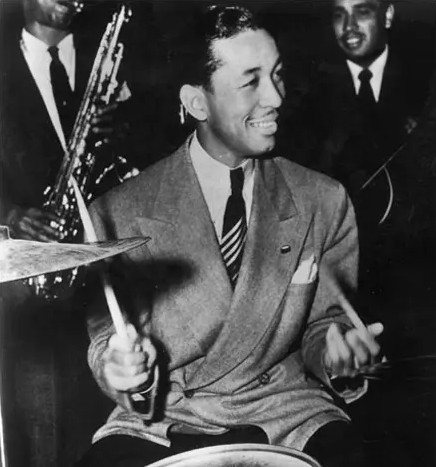
Leonidas Raymond Young was an American jazz drummer and singer. His musical family included his father Willis Young and his older brother, saxophonist Lester Young. In 1944 he played with Norman Granz’s first “Jazz at the Philharmonic” concert. In 1944 Lee Young was the drummer at Norman Granz’s first “Jazz at the Philharmonic” concert, which also featured guitarist Les Paul, trombonist J.J. Johnson, and saxophonist Jean-Baptiste “Illinois” Jacquet. Young played with such jazz and swing music notables as Mutt Carey, Fats Waller, Les Hite, Benny Goodman, and Lionel Hampton. In the 1950s Young played with Nat King Cole’s trio. From the 1960s on, he worked as an artist & repertory man for such record labels as Vee-Jay and Motown. Lee Young never recorded as a session leader.
George Coleman
March 8, 1935

“I love my job. I wake up in the morning, and I am ready to come to work, … I guess when I wake up one day and I don’t want to go, I will know it’s time for a change.”
George Coleman is an American jazz saxophonist known for his work with Miles Davis and Herbie Hancock in the 1960s. In 2015, he was named an NEA Jazz Master.
Ornette Coleman
March 9, 1930 – June 11, 2015

“It was when I found out I could make mistakes that I knew I was on to something.”
Ornette Coleman was an American jazz saxophonist, violinist, trumpeter, and composer. In the 1960s, he was one of the founders of free jazz, a term he invented for his album Free Jazz: A Collective Improvisation. His “Broadway Blues” and “Lonely Woman” have become standards and are cited as important early works in free jazz. His album Sound Grammar received the 2007 Pulitzer Prize for Music.
Jeanette Harris
March 9, 1979

“One day while driving me to 4th grade, Mom was playing a cassette by Grover Washington, Jr. I remember looking at the picture of his alto sax. It was beautiful and Grover made it look so hip. I felt it would be the perfect instrument for me.”
Jeanette Harris was born and raised in California’s post-Gold Rush town of Fresno in the centre of the San Joaquin Valley. Jeanette played saxophone and piano from grade school to high school where band teacher Steve Alcala also had her play in the Fresno City College jazz band even before she graduated high school. She won numerous awards and accolades, which led to a scholarship to attend Berklee in Boston where she earned a Bachelor of Arts degree in Music Performance.
Justin Kauflin
March 10, 1986

“His story is one of exceptional talent & artistic maturity, but it’s also one of triumph & optimism.”
Justin Kauflin an award-winning American blind jazz pianist, composer, producer, educator and Quincy Jones Artist. He performs worldwide, has recorded on 31 albums, composed the film score for the critically acclaimed documentary Keep On Keepin On, published 51 original compositions, produced 4 albums as leader and is on faculty for several jazz camps.
Carol Saboya
March 10, 1975

Carol Saboya is a Brazilian jazz singer. She is the daughter of composer Antônio Adolfo. She was raised surrounded by inspired chords, scribbled scores, and songs being born. When she was eight, she had her voice recorded for the first time. She spent three years studying singing in the United States, taking part in the Grammy-winning CD by Sérgio Mendes Brasileiro (1992), and in some of her father’s performances.
Mercer Ellington
March 11, 1919 – February 8, 1996
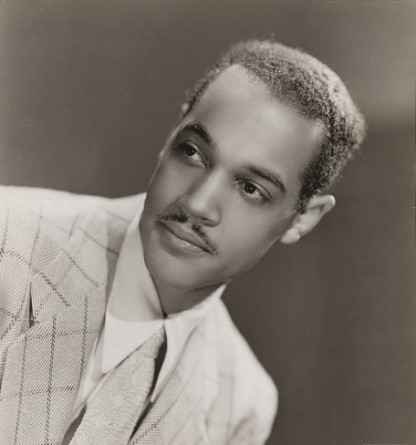
“The wise musicians are those who play what they can master.”
“No matter how good you sound, you don’t sound good to somebody.”
Mercer Kennedy Ellington was an American musician, composer, and arranger. His father was Duke Ellington, whose band Mercer led for 20 years after his father’s death. He was born in Washington, D.C.and grew up primarily in Harlem from the age of eight. By the age of eighteen, Ellington had written his first piece to be recorded by his father (“Pigeons and Peppers”). In 1939, 1959, and 1946 to 1949, Ellington led his own bands, many of whose members later performed with his father, or achieved a successful career in their own right (including Dizzy Gillespie, Kenny Dorham, Idrees Sulieman, Chico Hamilton, Charles Mingus, and Carmen McRae). During the 1940s, in particular, Ellington wrote pieces for his father’s band that became standards. When his father died in 1974, Ellington took over the orchestra, travelling on tour to Europe in 1975 and 1977.
Bill Anschell
March 12, 1959
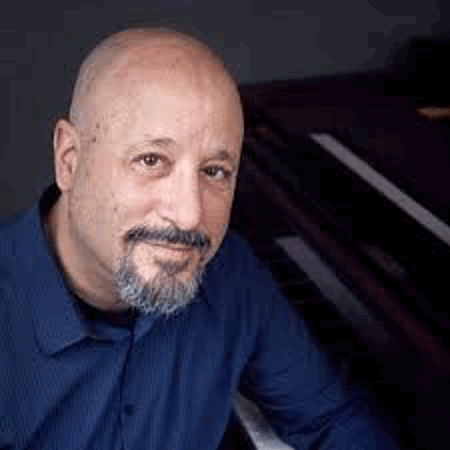
“In the world of jazz piano, going solo can be daunting; it means having to single-handedly (okay, double-handedly, but still?) assume roles more typically covered by at least three players. But, given an open mind and a deviant disposition, playing alone has its benefits. Harmonic progressions and steady time, which keep a band playing in tandem, suddenly become negotiable. Detours from a song’s form or tempo? Tangents that might cause a band to implode? Can lead to unexpected and inviting places: destinations where imagined figments find a welcoming home.“
Bill Anschell is a jazz pianist and composer. He has recorded seven CDs as a leader and performed or recorded with many jazz greats.
Roy Haynes
March 13, 1926 – November 12, 2024

“I’m still growing I take each day, one day-at-a-time. I’m always thinking and dreaming. As long as this heart keeps beating, there will be new things coming along.”
Roy Haynes is an American jazz drummer and group leader. Haynes is among the most recorded drummers in jazz, and in a career lasting over 70 years has played in a wide range of styles ranging from swing and bebop to jazz fusion and avant-garde jazz.
Quincy Jones
March 14, 1933 – November 3, 2024

“I learned real early why God gave us two ears and one mouth, because you’re supposed to listen twice as much as you talk.”
Quincy Jones is an American record producer, multi-instrumentalist, songwriter, composer, arranger, and film and television producer. His career spans over 60 years in the entertainment industry with a record 80 Grammy Award nominations, 28 Grammys, and a Grammy Legend Award in 1992.
Shirley Scott
March 14, 1934 – March 10, 2002

“All I was interested in was playing.”
Shirley Scott was an American jazz organist. Born in Philadelphia, Pennsylvania, Scott studied trumpet and piano in school. As a performer in the 1950s, she played the Hammond B-3 organ. Her recordings with Eddie “Lockjaw” Davis included the hit “In the Kitchen”. Influenced by gospel and blues, she played soul jazz in the 1960s with Stanley Turrentine.
Harry James
March 15, 1916 – July 5, 1983
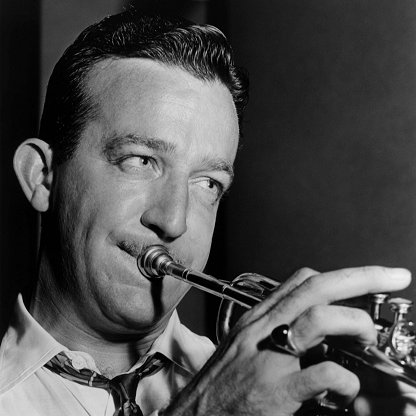
“Some of our most popular numbers are by the great classical composers.”
Harry Haag James was an American musician who is best known as a trumpet-playing band leader who led a big band to great commercial success from 1939 to 1946. He was especially known among musicians for his technical proficiency as well as his tone, and was influential on new trumpet players from the late 1930s into the 1940s. He was also an actor in a number of films that usually featured his band. James was born into a circus family and started performing with them at an early age. He started taking trumpet lessons from his father at age eight. In the early 1930s in Beaumont, Texas, James began playing in local dance bands when he was 15 years of age. In 1937 he joined Benny Goodman’s orchestra, where he stayed through 1938. He was nicknamed “The Hawk” early in his career for his ability to sight-read. A common joke was that if a fly landed on his written music, Harry James would play it. He debuted his own big band in 1939, adding a string section in 1941, and was then known as Harry James and His Music Makers. As of July 2018 the Harry James Orchestra, led by Fred Radke, was still very much in business.
Tommy Flanagan
March 16, 1930 – November 16, 2001

“Tommy is fondly remembered by loyal jazz fans, and his low-key but vital contributions to the art of jazz piano made it a richer place for all of us. Tommy Flanagan deserves a tribute of his own.”
Tommy Flanagan was an American jazz pianist and composer. Within months of moving to New York in 1956, he had recorded with Miles Davis and on Sonny Rollins’ landmark Saxophone Colossus. Recordings under various leaders, including the historically important Giant Steps of John Coltrane, and The Incredible Jazz Guitar of Wes Montgomery
Jessica Williams
March 17, 1948 – March 10, 2022

“But you don’t always have to say kind words, you know, as long as you always say the truth.”
Jessica Jennifer Williams is an American jazz pianist and composer. She started playing the piano at age four, and began music lessons with a private teacher at five. She studied classical music and ear training with Richard Aitken and George Bellows at the Peabody Conservatory of Music. At age twelve, Williams was listening to Dave Brubeck, Miles Davis, and Charles Mingus, and began performing jazz in her teens. In a radio interview with Marian McPartland on NPR’s Piano Jazz from 1992, she stated that her main influences were not pianists, but Miles Davis and John Coltrane. After a spinal operation in 2012, Williams ceased performing, but continued to make new music, including electronic music and neoclassical music.
Joe Locke
March 18, 1959
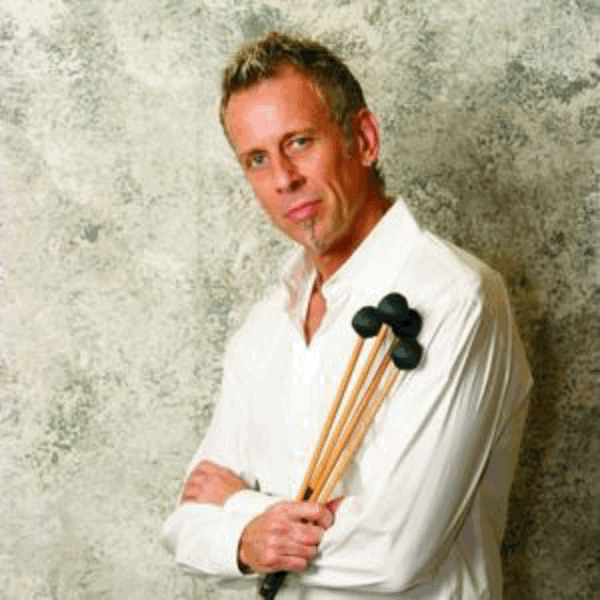
“I’ve always felt like great music can make you think and dance. The music on my latest album will hopefully make you do both.”
John Locke is an American jazz vibraphonist. A native of Palo Alto, California, Locke grew up in Rochester, New York. His father taught music. When Locke was eight years old he began learning drums and piano, then started on vibraphone five years later. After playing in rock bands, he became attracted to jazz in his teen years and attended the Eastman School of Music in Rochester. In 1981, he moved to New York City and worked as a sideman for Kenny Barron, Freddy Cole, Marvin Smith, and Eddie Henderson. His first solo album, Present Tense, was released by Steeplechase in 1990. He started the band Mutual Appreciation Society in 1999 with David Hazeltine, Essiet Essiet, and Billy Drummond and has recorded frequently with pianist Geoff Keezer. His album Four Walls of Freedom was based on the writings of Thomas Merton. In 2016 he was inducted into the Music Hall of Fame in Rochester. He has won the Mallet Instrumentalist of the Year Award from the Jazz Journalists’ Association several times.
Curley Russell
March 19, 1917 – July 3, 1986
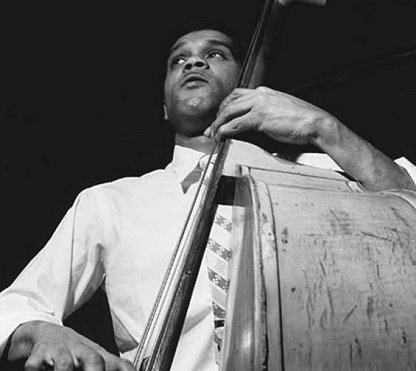
Dillon “Curley” Russell was an American jazz musician, who played bass on many bebop recordings. He was born in Trinidad, and was nicknamed “Curley” for his curly hair. After playing a bit of trombone, Russell switched to bass and he worked professionally from the age of 18. He was in demand for his ability to play at the rapid tempos typical of bebop, and appears on several key recordings of the 1940s. In 1951, Russell played in the recording session for “Un Poco Loco”, composed by American jazz pianist Bud Powell, with Max Roach on drums. Literary critic Harold Bloom included this performance on his short list of the greatest works of twentieth-century American art. Russell left the music business in the late 1950s. According to jazz historian Phil Schaap, the classic bebop tune “Donna Lee”, a contrafact on “Back Home Again in Indiana”, was named after Curley’s daughter. In 2002, she donated her father’s bass to the Institute of Jazz Studies at Rutgers University.
Marian McPartland OBE
March 20, 1918 – August 20, 2013

“I started to play Jazz music in my early teens. A boyfriend brought records over, so I listened to everything”
Margaret Marian McPartland OBE (née Turner) was an English-American jazz pianist, composer and writer. She was the host of Marian McPartland’s Piano Jazz on National Public Radio from 1978 to 2011. She demonstrated early aptitude at the piano, and would later realize that she had perfect pitch. Margaret (Maggie to her family) studied violin from the age of nine, but never took to the instrument. She also trained as a vocalist and received a number of favourable reviews in the local paper. Her mother refused to find her daughter a piano teacher until the age of 16, by which time she was already adept at learning songs by ear. This lack of early education meant that Margaret was never a strong reader of notated music, and would always prefer to learn through listening.
“Sir” Charles Thompson
March 21, 1918 – June 16, 2016
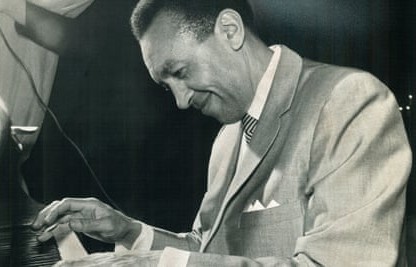
Charles Phillip Thompson was an American swing and bebop pianist, organist, composer, and arranger. First studying the violin, and briefly tenor saxophone, Thompson later took up piano as a teenager. By the age of twelve, he was playing private parties with Bennie Moten and his band in Colorado Springs, Colorado. During this time, Count Basie played off and on with Moten’s band. During a show, Basie called Thompson up to perform. He was dubbed “Sir Charles Thompson” by Lester Young. Thompson chiefly worked with small groups, including the Coleman Hawkins/Howard McGhee sextet in 1944–1945. Throughout the 1940s he played and recorded with Charlie Parker, Dexter Gordon, Miles Davis, and J. C. Heard, among others. He worked freelance, principally on organ, for much of the 1950s. He played with Parker again in 1953, recorded with Vic Dickenson and Buck Clayton and headed his own quartet in 1959. In the early 1960s, he toured Europe and Canada with Buck Clayton. Thompson composed the jazz standard “Robbins’ Nest”.
George Benson
March 22, 1943
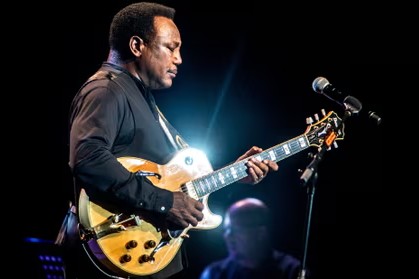
“The less one remembers about the day before, the more the new day will be unfettered by triviality.”
George Washington Benson is an American jazz fusion guitarist, singer, and songwriter. He began his professional career at the age of 19 as a jazz guitarist. A former child prodigy, Benson first came to prominence in the 1960s, playing soul jazz with Jack McDuff and others. He then launched a successful solo career, alternating between jazz, pop, R&B singing, and scat singing. His album Breezin’ was certified triple-platinum, hitting No. 1 on the Billboard album chart in 1976. His concerts were well attended through the 1980s, and he still has a large following. Benson has won ten Grammy Awards and has been honoured with a star on the Hollywood Walk of Fame. By the mid-to-late 1970s, as he recorded for Warner Bros. Records, a whole new audience began to discover Benson. On 1976’s Breezin’, Benson sang a lead vocal on the track “This Masquerade”, a song written by Leon Russell. Benson’s version (notable also for the lush, romantic piano intro and solo by Jorge Dalto), became a huge pop hit and won a Grammy Award for Record of the Year. The rest of the album is instrumental, including his rendition of the 1975 José Feliciano composition “Affirmation”.
Dave Frishberg
March 23, 1923 – November 17, 2021
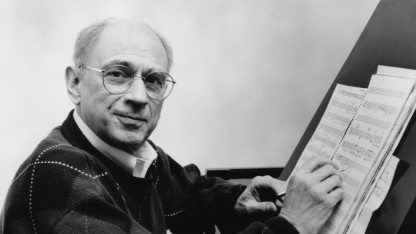
“I am a piano player first, who summoned up the nerve to sing his songs in front of people.”
David Lee Frishberg was an American jazz pianist, vocalist, composer, and lyricist. His songs have been performed by Blossom Dearie, Rosemary Clooney, Shirley Horn, Anita O’Day, Michael Feinstein, Irene Kral, Diana Krall, Rebecca Kilgore, Stacey Kent, Bette Midler, John Pizzarelli, Jessica Molaskey, and Mel Tormé. Frishberg resisted learning classical piano as a boy, developing an interest in blues and boogie-woogie by listening to recordings by Pete Johnson and Jay McShann. As a teenager, he played in the house band at the Flame in St. Paul where Art Tatum, Billie Holiday, and Johnny Hodges appeared. In 1957, Frishberg moved to New York City, where he played solo piano at the Duplex in Greenwich Village. He first became known for his work with Carmen McRae, Ben Webster, Gene Krupa, Bud Freeman, Eddie Condon, Al Cohn, and Zoot Sims. Later, he was celebrated for writing and performing his own, frequently humorous, songs, including favourites “I’m Hip” (lyrics only, in collaboration with Bob Dorough), “Blizzard of Lies”, “My Attorney Bernie”, “Do You Miss New York”, “Peel Me a Grape”, “Quality Time”, “Slappin’ the Cakes on Me”, “I Want To Be A Sideman”, and “Van Lingle Mungo”, whose lyrics consist entirely of the names of old-time baseball players.
Vince Jones
March 24, 1952

““It’s easy to keep doing what I love.”
Vince Jones is a jazz singer, songwriter, and trumpet, flugelhorn and flumpet player. The family moved to Australia in 1964 and they lived in Wollongong and Jones attended high school. He attributes his love of jazz to hearing Miles Davis’s album Sketches of Spain, when he was about 14 and taught himself to play the trumpet. Jones began his career in 1974 as a bebop trumpet player on the club and jazz circuit. In November 1981 Jones recorded his debut album, Watch What Happens. His music includes both original material and new contemporary versions of jazz standards. His themes are often love, inequity, injustice, peace and anti-greed.
Aretha Franklin
March 25, 1942 – August 16, 2018

“We all require and want respect, man or woman, black or white.
It’s our basic human right.”
Aretha Louise Franklin was an American singer, songwriter and pianist. Honored as the “Queen of Soul”, she was twice named by Rolling Stone magazine as the greatest singer of all time. One of the giants of soul music, and indeed of American pop as a whole. She epitomised soul, often regarded as a symbol of Black America, although she never thought of herself as confined to one genre. Her eclectic choice of material maintained creative momentum, from gospel to Simon & Garfunkel.
James Moody
March 26, 1925 – December 9, 2010
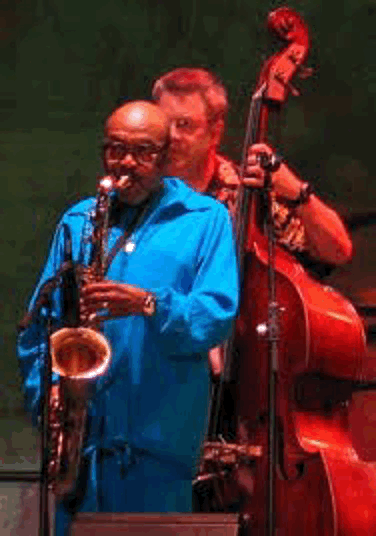
“I’ve done what I’ve done but it’s not enough. I’m a student of jazz and there’s just so much more to learn.”
James Moody was an American jazz saxophone and flute player and very occasional vocalist, playing predominantly in the bebop and hard bop styles. James Moody took up the alto sax, a gift from his uncle, at the age of 16. Within a few years, he fell under the spell of the deeper more full-bodied tenor saxophone after hearing Buddy Tate and Don Byas perform with the Count Basie Band. For over six decades, he serenaded lovers with his signature song ‘Moody’s Mood for Love’, an improvisation on the chord progressions of ‘I’m in the Mood for Love’.
Sarah Vaughan
March 27, 1924 to April 3, 1990

“There are notes between notes, you know.”
Sarah Lois Vaughan was an American jazz singer and pianist. Nicknamed “Sassy” and “The Divine One”, she won two Grammy Awards, including the Lifetime Achievement Award, and was nominated for a total of nine Grammy Awards. Critic Scott Yanow wrote that she had “one of the most wondrous voices of the 20th century”. In the 1940s, when most women singers adorned big bands as stage attractions and not legitimate jazz musicians, Sarah Vaughan elevated the vocalist’s role as equal with the jazz instrumentalist. She was known for her dynamic vocal range, sophisticated harmonies, and horn-like phrasing over a five decade career.
Thad Jones
March 28, 1923 – August 20, 1986
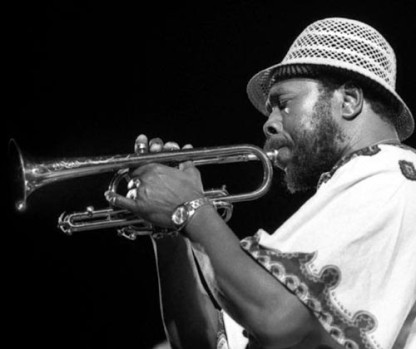
“I have never formally studied arranging. The things that I have written I have acquired through experience, but talent is not all. You have to work at it. Having somebody like Ellington as a guideline certainly didn’t hurt.”
Thaddeus Joseph Jones was an American jazz trumpeter, composer and bandleader who has been called “one of the all-time greatest jazz trumpet soloists”. He was a brother of pianist Hank Jones and drummer Elvin Jones. A self-taught musician, Thad began performing professionally at the age of 16. Many years later, while teaching jazz at the Royal Danish Conservatory in Copenhagen, Jones studied composition formally during this period. He also began learning the valve trombone. Jones became a member of the Count Basie Orchestra in May 1954. His main contribution to Basie’s organization was nearly two dozen arrangements and compositions, which included “The Deacon”, “H.R.H.” (Her Royal Highness – in honour of the band’s command performance in London), “Counter Block” and lesser-known tracks such as “Speaking of Sounds”. The recording Dance Along with Basie contains nearly an entire album of Jones’s uncredited arrangements of standard tunes. In 1959, Jones played cornet on Thelonious Monk’s 5 by Monk by 5 album.
Astrud Gilberto
March 29, 1940 – May 5, 2023

“Music speaks when words fail.”
Astrud Gilberto (born Astrud Evangelina Weinert) was a Brazilian samba and bossa nova singer and songwriter. She gained international attention in the mid-1960s following her recording of the song “The Girl from Ipanema”, and is often referred to as ‘The Queen of Bossa-Nova’ with roots firmly planted in Brazilian music. Her music is a combination of the sensual rhythms of Brazil and American pop and jazz. Gilberto received the Latin Jazz USA Award for Lifetime Achievement in 1992 and was inducted into the International Latin Music Hall of Fame in 2002. In 1996, she contributed to the AIDS benefit album Red Hot + Rio, performing the song “Desafinado” (Portuguese for “slightly out of tune”, or “off-key”) along with George Michael at his invitation.
Norah Jones
March 30, 1979
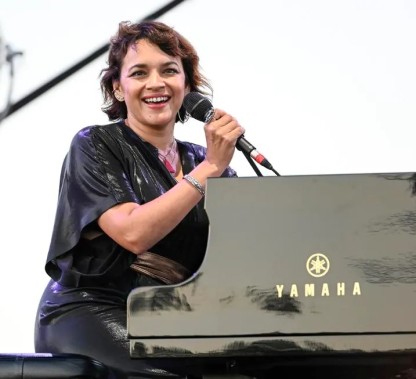
“Without a piano I don’t know how to stand, don’t know what to do with my hands.”
Norah Jones (born Geethali Shankar) is an American singer-songwriter and musician, the daughter of Indian sitarist and composer Ravi Shankar, and the half-sister of fellow Indian musicians Anoushka Shankar and Shubhendra Shankar. She has won several awards for her music and, as of 2023, has sold more than 53 million records worldwide. Billboard named her the top jazz artist of the 2000s decade. She has won ten Grammy Awards and was ranked 60th on Billboard magazine’s artists of the 2000s decade chart. Jones always had an affinity for the music of Bill Evans and Billie Holiday, among other “oldies”. She once said, “My mom had this eight-album Billie Holiday set; I picked out one disc that I liked and played that over and over again”.
Freddie Green
March 31, 1911 – March 1, 1987
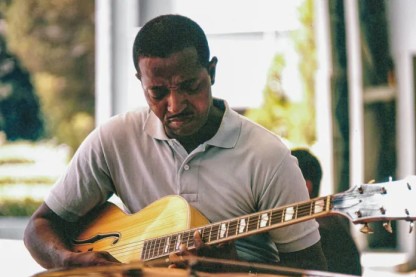
“You should never hear the guitar by itself. It should be part of the drums so it sounds like the drummer is playing chords – like the snare is in A or the hi-hat in D minor.”
Frederick William Green was an American swing jazz guitarist who played rhythm guitar with the Count Basie Orchestra. He learned the banjo before picking up the guitar in his early teenage years. A friend of his father by the name of Sam Walker taught Freddie to read music, and keenly encouraged him to keep up his guitar playing. Walker gave Freddie what was perhaps his first gig, playing with a local community group, another member of which was William “Cat” Anderson, who went on to become an established trumpeter, working with notable figures such as Duke Ellington. In 1937, Basie and his ensemble went to one of Green’s gigs on the advice of an associate. Basie was an immediate fan, and approached Green with a job offer. Except for a brief interruption, Freddie Green would remain a pivotal fixture of the Count Basie Band for the next fifty years. He rapidly changed chords, often with every beat, rather than every measure. His chord fingering often involved him covering four strings with his fingers, while depressing only a subset of the notes. He dampened the unsounded notes from chords with his left hand. Green’s playing on his signature Stromberg guitar was the model for Ralph Patt’s big-band playing.