
Related program: Passion and Melancholy on Wednesday 4 February at 2pm.
The 400th anniversary of the death of John Dowland
By Susan Foulcher
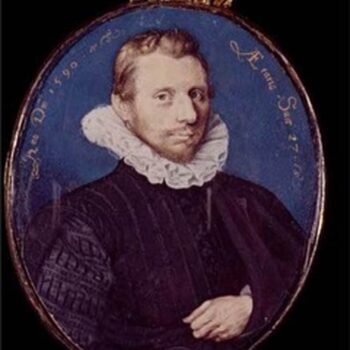
In February 2026 we mark the 400th anniversary of the death of John Dowland, one of the Elizabethan era’s most brilliant lutenists and most influential composers. He is accepted to be the creator of the English lute-song, composer of a large collection of masterly and virtuosic repertoire for lute, and a musical voice which encapsulated the cultural and literary cult of melancholia which erupted in England during his lifetime. With this level of renown and popularity, it’s remarkable that so little factual information exists and there are many aspects of his life that remain controversial.
Firstly, we don’t know where Dowland was born. Some say Dublin, others say London or even pinpoint Westminster. What’s more unusual is that we also don’t know the date of his death, just that his court salary stopped in January 1626, and he was buried a month later – we don’t know why he died or the reason for the delay in burying him.
It’s also a mystery why Dowland was passed over, again and again, for a court lutenist position despite his considerable fame and reputation. Travelling often to Europe, colourful rumours suggest that he was a spy, but, again, there’s no real evidence for this, although he did communicate with Queen Elizabeth’s ‘spymaster’, Sir Robert Cecil. We don’t even know what he looked like, although there’s been a lot of speculation and several possible portraits have been put forward.
Dowland was 50 when he was finally successful for a position in the court of James I, but he never cracked the Elizabethan court, despite many applications. Musical geniuses of the past were often considered ‘prickly’ personalities and Dowland appears to have fallen into this category. He had his supporters in England, but at the time it was suggested that Dowland was often his own worst enemy when it came to forwarding his career. Disappointed after these rejections, his criticisms of the establishment and of large sections of his profession, and even particular musicians, were often severe and verging on paranoid.
As a younger man, despondent from his lack of success, he travelled abroad several times, working in Paris, Germany, Italy and, finally, for 8 years in Denmark. Offers from European courts were enthusiastic and made on flattering terms. It’s quite obvious that he was valued and revered there. Noblemen in Germany made repeated offers to him and wrote to him in glowing and friendly terms, and Christian IV of Denmark paid him one of the largest salaries of any of his court servants.
Our knowledge of Dowland’s life is patchy, but we do know that he was a bit of a publishing powerhouse, for everything but his solo lute pieces. His First Booke of Songes or Ayres appeared in 1597, when he was 34. A set of 21 lute-songs, many written considerably earlier, this book was a runaway success and was reprinted at least four times before 1614. The collection effectively defined the new English lute-song genre, and Dowland had also devised the printed format of the single folio ‘table layout’ for this publication. The format artfully combined both lute tablature with staff notation for singers and instrumental players. Dowland was revealed to be a songwriting master with a consummate gift for melody and word setting, and for making precise connections between poetic metre and musical rhythm. These songs were received as flawless masterpieces.
His second and third books of songs were published in 1600 and 1603 respectively. They demonstrated greater complexity than his earlier songs, with pieces of a more serious nature accompanied by more intricate, contrapuntal lute parts and sometimes lower voices. Flow my teares, his most famous song, appears in the second book. It’s based on his solo lute piece Lachrimae Pavan, which employs the famous ‘tear motif’ and was written around 1595. Dowland regarded this work as his greatest composition and used it again as the basis of his brilliantly conceived instrumental collection Lachrimae, or Seaven Teares.
The innovative Lachrimae or Seaven Teares was published in 1604. The idea of a cycle of seven pavans, linked thematically but utilising a variation sequence, was something quite new. It explored emotional extremes of feeling and illustrated states of melancholy which were being written about by various Elizabethan and Jacobean writers of the period. Accompanying the seven Lachrimae were 14 dances, including the famous Semper Dowland semper Dolens (Always Dowland, always doleful). Most of these are lively galliards, a dance form which Dowland used extensively, and he described the variety within the work as mixing ‘grave with light’. This collection marked an important step in the development of autonomous, abstract instrumental music and the pieces within it have become performance favourites with players the world over.
As mentioned previously, Dowland’s 100-odd lute solos were not published adequately under his name. Mostly, they exist only in prints and manuscripts of uncertain provenance and accuracy, and variants from his contemporaries. Dowland’s lute music is extremely diverse, using every then-current instrumental form, and ranging from dances to free fantasias displaying supreme contrapuntal skills. Many bear the names of courtiers and monarchs of the day, but his witty miniature masterpieces also celebrate characters from decidedly lower circles – examples ranging from the Earl of Essex Galiard to The Shoemaker’s Wife: A toy.
Finally, in 1612, the long-awaited position arrived in the court of James I and, with it, Dowland’s output virtually stopped. A Pilgrimes Solace, a collection of secular and devotional partsongs and solo songs with varied accompaniment, was published the same year. It’s been described as the ‘last magnificent flowering of his genius’, but comments he made at the time show that he accepted that his days of composing were almost done.
Today, Dowland is renowned for the melancholy which pervades so many of his works, but was his personality ‘always doleful’ or did he use the recurring images of tears, darkness and death to tap into the then-fashionable idea of melancholy as beautiful sadness? He certainly also wrote light-hearted, happy works like Away with these self-loving lads, Fine knacks for ladies and many witty and cheerful galliards for lute or viol consort. We’re left with an impression of Dowland as an intense genius, well aware of his own musical prowess but frustrated by the lack of recognition he received in his own country. We’ll never know whether his influence on much later musicians, such as Benjamin Britten and Percy Grainger, many others from the early music revival, and even pop music icons like Elvis Costello and Sting, would have assuaged the bitterness he felt during his lifetime.