
Paul Roper evaluates Carl Maria von Weber: composer, conductor, opera producer, pianist, critic
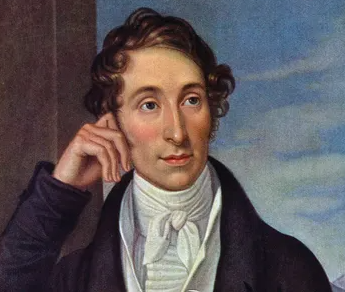
Music history typically looks for parallels between artists of different eras, circumstances or backgrounds. Weber and Mozart are an obvious pairing. Born 30 years apart, both died young, both were acclaimed pianists and both massively reshaped opera in response to the cultural and aesthetic currents around them.
There is also a slender family connection: an uncle of Constanze Mozart (nee Weber) was Weber’s father, Franz Anton. This fact itself illustrates how history can be recursive. Mozart first met Constanze when he visited Mannheim, then a musical centre of outstanding fame, in 1777. Thirty-three years later, after Weber and his father were banished from the Kingdom of Württemberg for financial indiscretions, they chose Mannheim as their place of refuge.
A peripatetic childhood is something else they shared: Mozart as a child prodigy on his concert tours, Weber as a member of his father’s travelling theatre troupe, receiving very early exposure to music and drama and the interaction between them.
In 1798 the company’s travels took them to Salzburg, where the 11-year-old Weber studied under Michael Haydn. But his most influential teacher was the remarkable, bizarre and controversial Georg Joseph Vogler, with whom he studied in Vienna from 1803. (Mozart called Vogler a dreary musical jester; others termed him a charlatan.)
That same year Vogler recommended him for the position of Capellmeister at Breslau (now Wrocław, Poland), which he took up at 17, learning Czech so he could communicate more fully with his team. In obtaining further formal, and increasingly prestigious, appointments – at Carlsruhe (1806-1807), Stuttgart (1807-1810, which ended in exile), Prague (1813-1817) and Dresden (1817-1826) – he achieved what Mozart could not. In Prague he was director of the opera, a house that opened in 1783 and had a short but distinguished history.
Don Giovanni had its premiere in Prague and it was also there that Mozart conducted La Clemenza di Tito. Weber maintained a punishing workload of administration, production, auditioning, rehearsing and conducting – including, for example, nine different operas in the first three months of 1814. He staged Beethoven’s Fidelio in November 1815.
At the same time he continued the part-time work he’d begun in 1809 as a journalist and music critic, his writings showing keen perception and wit. A comment ascribed to Weber that Beethoven ‘must be ready for the madhouse’ because of his Symphony no 7, did not, in fact, come from him.
Exhausted, Weber resigned from Prague in late 1816 and became music director at the Saxon Court at Dresden early the following year. There, too, his schedule was demanding, a fact aggravated by the frequent health problems of his superior, the Capellmeister Francesco Morlacchi.
Again, opera was his main focus, but with the added complication of tensions between adherents of the established Italian opera tradition (championed by Morlacchi) and the rapidly emerging German alternative. Clearly, the latter was where Weber’s sympathies lay: three of the works for which he’s most famous – Abu Hassan (1811), Der Freischütz (1821) and Euryanthe (1823) – all have German libretti. The fourth, Oberon (1826), was written for England to an English libretto, but Weber had been introduced to the story via a German source.
The German operas represent different genres. With its Middle Eastern setting, the one-act Abu Hassan draws on the so-called ‘Turkish’ mode that had fascinated Europeans since the Ottoman siege of Vienna in 1683 and with renewed enthusiasm a century or so later. Relying as it does on spoken dialogue, it inhabits the category of the Singspiel (literally, ‘singing play’). In both respects, Abu Hassan has been compared to Mozart’s Seraglio.
Der Freischütz also makes extensive use of the spoken word, but the subject matter is simultaneously more serious and more ‘popular’. The supernatural is invoked, the joys of the hunt and the forest are extolled and the intervention of a solitary religious figure (a hermit) prevents harm and facilitates the happy ending for lovers Max and Agathe.
Commissioned by a major theatre in Vienna, Euryanthe abandons the spoken word altogether in favour of ‘standard’ accompanied recitative and, for that reason, Weber designated it a grand opera. Set in medieval France, its story about a husband who is challenged over his wife’s fidelity has a passing resemblance to that of Cosi fan tutte. But the libretto, by the writer who produced the play Rosamunde, Princess of Cyprus, which is remembered solely for the incidental music Schubert provided for it, has generally been poorly regarded. Oberon reverts to passages of speech – in English – and has no recitative.
Some of these elements embody the favoured Romantic aesthetic of the time: a fascination with chivalric tales, celebration of the power and beauty of nature, horror and the supernatural, the notion of the ‘bargain with the devil’ (as personified in the Faust story), individual freedom in the face of tyranny, rescue and revenge and growing ‘localist’ sentiment, partly in reaction against supranational cultural, military and political forces: Italian opera, Napoleonic expansion, the Austrian empire.
These themes had been extensively explored in literature but by Weber’s time were gaining ground as subjects for opera (and had been since the mid-1770s). It was Weber’s achievement in his major operas to bring these elements together in extended music drama, using the new and fresh musical language of the early 19th century. Unenthused by the Italian tradition, he looked to opera from France as an important model. The context, setting and intended audience might mainly have been German, but the reception transcended national and language boundaries: Der Freischütz had reached London by 1824 and Stockholm by 1838 and Oberon was given in Leipzig in 1826, Budapest in 1829 and Paris in 1830.
Weber’s music influenced and was greatly admired by Wagner and by Berlioz, who, to his great disappointment, just missed meeting Weber in Paris on his way to London in 1825. He was an early exponent of the leitmotif technique, where specific melodies are associated with particular characters and transformed to suit the dramatic context. As a tantalising instance of what might have been, Weber was given a version of the story of Tannhäuser in 1816 but preliminary discussions about turning it into a libretto went nowhere.
He was also a fine and acclaimed pianist, and stylistic debts can be seen in the piano works of Mendelssohn, Chopin and Liszt. The composer Julius Benedict, Weber’s pupil and assistant in 1821, wrote:
Having the advantage of a very large hand, and being able to play tenths with the same facility as octaves, Weber produced the most startling effects of sonority and possessed the power, like [Anton] Rubinstein, to elicit an almost vocal quality of tone where delicacy or deep expression were required.
His piano works include four sonatas, two concertos and a descriptive Concert piece (which Stravinsky admired), several sets of variations and the Invitation to the Dance, which Berlioz famously orchestrated as a homage in 1841. The piano also features in much of Weber’s chamber music.
The reference to his physical strength as a pianist is a happy contrast with his health overall. He walked with a limp and, in his late teens, had weakened his voice by accidentally drinking printing chemicals used in one of his father’s failed business ventures. From 1812, aged 26, he displayed symptoms of the tuberculosis which had killed his mother when he was 12 and would increasingly debilitate and eventually claim him in London at the age of 39. He had travelled there against his doctors’ advice to compose and conduct Oberon (adding English to his range of languages).
It is likely that his constant travels and phenomenal pace of work in his various jobs contributed to his physical vulnerability. Despite his ill health he enjoyed solitary walks in the woods as a stimulus to composition. He maintained a happy household with his wife Caroline (nee Brandt), a talented soprano whom he recruited for the Prague opera, their two surviving children and various pets (dogs and, for a time, a monkey).
As well as the cities in which he worked, Weber was a frequent and welcome visitor in Berlin, where Giacomo Meyerbeer and his family became good friends and supporters. Der Freischütz had its premiere there, in 1821, to inaugurate the new opera house, with the poet Heine and the 12-year-old Mendelssohn (whom Weber had met) in the audience. Weber’s depiction of the fairy world in Oberon, which Mendelssohn probably saw on a visit to England, would influence Mendelssohn’s music for A Midsummer Night’s Dream.
Always a sociable individual, in his earlier years Weber wrote part songs for convivial group singing and enjoyed strolling the streets in the evening with friends, guitar in hand and singing Lieder. He composed more than 80 solo songs.
Other close friends were the composer Franz Danzi, whom he met in Stuttgart; the composer and conductor Ludwig Spohr and the celebrated clarinettist Heinrich Baermann (from Munich). Weber and Baermann toured together and Weber, who shared with Mozart an affection for the clarinet, composed a series of characteristic and virtuoso works – two concertos, a concertino, the quintet and the Grand duo – for him.
Such was Wagner’s veneration of Weber that in 1844 he organised the repatriation of his remains from London to Dresden, funding it with the proceeds of a Berlin performance of Euryanthe conducted by Meyerbeer. Wagner later wrote: ‘I had learned to love music by way of my admiration of Weber’s genius’.
In their different ways, Mahler and Hindemith both paid explicit tributes: Mahler with his completion and revival (in 1888) of Weber’s unfinished opera Der Drei Pintos (1821-1824) and Hindemith through his Symphonic Metamorphoses (1943) of some of Weber’s piano duets and his incidental music (1809) to Schiller’s play Turandot – the same story Puccini was to use a century later.
In his classic study of Weber (1976), the English writer and critic John Warrack (still living, aged 98, at time of writing) observes that Weber’s
gentleness, his sharp wit, his acute perception of the world as a colourful tragi-comic drama make him a particularly human and diverse composer, and his genius for dramatising experience of almost any kind into music ensured that he became an exceptionally lucid mirror of [his] age.
His appeal remains undiminished. 2MBS Fine Music Sydney will commemorate the 200th anniversary of Weber’s death (5 June 1826) with several streams of programming from April to June:
- In At the Opera (8pm Wednesdays), Oberon will go to air on 8 April, Der Freischütz on 20 May and Euryanthe on 10 June.
- Two editions of Sunday Special (3pm Sundays) on 7 and 21 June will be devoted to Weber, his friends and contemporaries
- A series of five programmes focusing on Weber’s clarinet music will be broadcast on Tuesday 2, 9, 16, 23 and 30 June at 3pm