
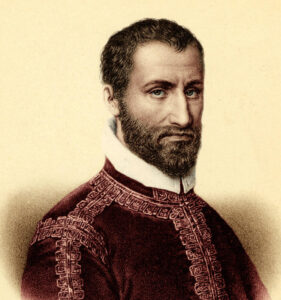
Superlative descriptions of Palestrina’s music and influence are not hard to find in this 500th anniversary of the composer’s birth. The ‘Anno Pierluigiano’ celebration is in full swing in Italy, encompassing a busy year of concerts in the Cathedral Basilica of Palestrina, and there has even been a commemorative stamp issued, which was
accompanied by the release of a CD of Palestrina’s works and a performance of his most famous mass, the Missa Papae Marcelli, with His Holiness Pope Leo XIV in attendance. To call Palestrina a ‘towering figure’ in late 16th century music, with an influence that continued for centuries, doesn’t appear to be an overstatement. The legend of Palestrina began even before his death in 1594, and never waned, increasing in vigour in the 17th, 18th and 19th centuries – a feat not achieved by any other composer. Indeed, he is still acknowledged to be the greatest composer of the Catholic Church and is still held up to music students today as a model of polyphonic writing.
However, it has often been said that other composers, like Lassus, had a more
expressive, dramatic approach and William Byrd’s output was far more versatile and
also showed a mastery of polyphonic music in the Catholic tradition. What was it
about Palestrina’s music that has so captured the musical imagination over ensuing
centuries, keeping his iconic stature alive?
To start with, his output was simply enormous and focused on sacred music. A total
of 104 masses are securely attributed to him – more than to any other composer of
his age – and to this can be added more than 300 motets, 68 offertories, 72 hymns,
35 Magnificat settings, 11 litanies and four or five sets of Lamentations. He was also
an important madrigalist, composing 140, to both sacred and secular poetry.
For his sacred output, he preferred Roman publishers because they used the large
choir book format favoured by Roman churches, even though it was expensive. This
would, to some extent, have encouraged the performance of Palestrina’s work, at
least in the churches of his home city. Six books of masses were published during his lifetime,
with a further seven appearing in rapid succession after his death. And what a treasure trove these masses are! They contain every ‘type’ of mass used in the 16th century.
He wrote many ‘parody’ masses, using material from pre-existing works. Some (usually later masses) are based on his own compositions, and a larger number derived from works by French, Flemish and Spanish composers from within the Roman church environment, demonstrating the important influence of the
Franco-Flemish tradition on Palestrina’s work.
Added to these were many paraphrase masses, a few tenor masses, canonic masses
and some freely composed masses, like the famous Missa Papae Marcelli, which was
sung at papal coronation services for centuries and was specifically composed for the
intelligibility of the text.
This last point leads us to one of the major forces in Palestrina’s life as a composer
for the Catholic church: the 18-year Council of Trent (from 1545 to 1563), which led
to the Catholic Counter-Reformation. The guidelines it emphasised for church music
included the removal of ‘impure’ secular elements as well as a stipulation that the
sacred texts had to be clearly evident and weren’t to be obscured by the music.
While many have interpreted these musical restrictions as an impediment to
creativity, for Palestrina they seem to have been a huge opportunity. There was a
feeling that new, forward-looking music, with increased textural clarity, was required,
and Palestrina was advantageously placed to provide it. The development of his
masses as the century progressed clearly shows his implementation of the new
guidelines. Stylistically varied, they range from the consistently contrapuntal,
massive, brilliant masterworks of his early career (such as the Missa Benedicta es
caelorum regina) to the compact, largely homophonic later works that employ
declamatory, richly chordal music in which every word of the text is clear (the Missa
Assumpta es Maria is a good example).
Other practical considerations shaped Palestrina’s career over the years. While most
of his musical colleagues in Rome were celibate clerics, he was a married man who
took his family commitments very seriously. This affected his life as a composer and
musician in both positive and negative ways. He was expelled after a very short time
as a singer in the Papal choir due to his marital status, after the lenient pope who
had supported him died. And while he considered taking orders when his first wife
died, he changed his mind and married again only eight months later.
His second wife was a well-to-do widow whose money smoothed the way for Palestrina to
publish an enormous amount of his work in the last 12 years of his life.
Palestrina demonstrated throughout his life that he had a good head for business.
He was actively involved in his second wife’s business, purchased a portfolio of
properties, and sold altar wine from his family vineyard. As a musician, he protected
his interests, negotiating advantageous salaries as his fame increased and flattering
offers from other courts were received. And he had always ensured the support of
influential friends in high places by dedicating his published works to them. By the
end of his life other musicians held him in awe.
The legend surrounding Palestrina’s work may have been amplified by the now
discredited story that he was the ‘saviour of church music’ in the aftermath of the
Council of Trent, but one other important development assisted with the continuation
of his iconic stature. Eighteenth-century composer and theorist Johann Joseph Fux
published a ‘counterpoint manual’ in 1725, citing Palestrina as his model, and this
method was widely adopted and used for contrapuntal training in the 19th century.
Many later composers, among them J S Bach, Mendelssohn and Barsanti, adapted
and praised his work. Palestrina has long been held up to composition students as
the pinnacle of pure counterpoint.
In the end, Palestrina’s music speaks for itself and corroborates his stature. His work
was serene, balanced, and restrained; its style appropriate to the ecclesiastical
occasion for which it was written. It’s also evident that he was at the forefront of
composition which married the beauty and spiritual aesthetic of sacred music with
the functional aims of the Roman Catholic church at a time of considerable
upheaval.
Tune in to the various anniversary programmes planned for October and November,
to hear some of Palestrina’s ethereally beautiful sacred work – masses, motets and
magnificats – that show why he is still revered 500 years on.
Susan Foulcher