
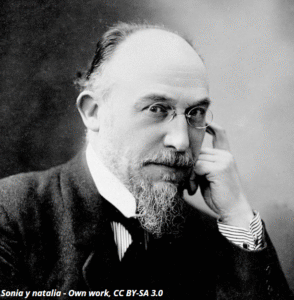
Born in 1866 in the ancient fishing port of Honfleur, Normandy, the uniquely idiosyncratic composer Eric Alfred Leslie Satie, who later identified himself simply as Erik Satie, died 100 years ago, on 1 July 1925.
He was the oldest child of an English Protestant mother of Scottish descent and a French Catholic father, a shipping broker turned music publisher, who in 1887 published his son’s first compositions. Satie wrote no operas, no symphonies, no concertos and precious little chamber music, although others have produced various chamber arrangements of his works. He also wrote no sonatas.
Yet because of his personal unconventionality and the originality of his musical experiments he is seen as having influenced a whole new generation of French composers away from post-Wagnerian Impressionism and towards a sparer and terser ‘modern’ style.
This highlights an important characteristic of Satie’s music: the almost total absence of any trace of subjectivity, both as a matter of style and also, as Ornella Volta in one of her several books on the composer observes: ‘the better to sidestep any explicit – or implicit – allusion to his private life’.
Satie lived in Honfleur until 1870, when the family relocated to Paris. Two years later, after his mother had died, he was sent back to Honfleur to live with his grandparents. When his grandmother died in 1878 he was again returned to Paris where, instead of his attending school, an informal education was organised for him. His father’s new wife, a piano teacher and mediocre composer who Erik quite disliked, decided that her eldest stepson should become a professional musician.
So, in 1879 he entered the Conservatoire, which he also disliked, where the records show him as gifted, extraordinarily lazy and often absent. The result was that instead of obtaining a diploma, he was dismissed in 1882 for failing to reach the required standard. Nonetheless he persisted with harmony and piano studies for the next few years, possibly hoping to qualify for the one-year volontariat in lieu of five years’ compulsory military service.
This manoeuvre seems to have failed, although his term in the military was limited to about six months before he was discharged because of a severe and deliberately self-inflicted bout of bronchitis. Many years later, during the war, he did serve as a corporal in the militia, performing what James Harding describes in The Ox on the Roof as ‘duties of baffling vagueness’ in Arcueil.
In 1905, at nearly 40, Satie made the remarkable decision to enrol at the Schola Cantorum, the austerely rigorous institution founded by Vincent d’Indy ten years earlier (as an alternative to the Conservatoire), where the official philosophy was to consider music an art, not merely a craft. Several friends, including Roussel and Debussy, sought to dissuade him, feeling he was already a fully-fledged musician whose unique style might be destroyed in the process. Nonetheless, acutely aware of his technical shortcomings at that time, he persevered with his studies and in 1908 graduated with first class honours and a diploma in counterpoint.
Satie never married. His only known liaison, a brief and stormy one at that, was with the artist Suzanne Valadon, best known as the mother of Maurice Utrillo. As to his living arrangements: on quitting the family residence in 1887 after a quarrel over an alleged liaison with the family maid, he lived briefly in lodgings, then in a single small room – hardly more than a closet – in Montmartre and then, from 1898, in a somewhat larger room over a dingy café in the grimy suburb of Arcueil, on the southern outskirts of Paris.
When the money he had left home with ran out, and intermittently thereafter, he worked as a pianist and composer of cabaret-style songs and incidental music in establishments such as the Chat Noir and the Auberge de Clou. At times he also played the piano and accompanied singers at society soirées, which he disliked, apparently considering them ‘a great lowering’.
Always neatly dressed and publicly urbane, over the years Satie adopted various images, including a period in quasi-priestly dress, another in which he always wore identical grey velvet suits – of which he had no fewer than 12, earning him the nickname of ‘The Velvet Gentleman’.
But he was particularly known for his final persona: a neat bourgeois costume with bowler hat, wing collar and umbrella, the latter a kind of talisman he carried with him everywhere. He kept dozens at home, for he adored wet weather and detested sunshine. An interesting aspect of these guises, and something Satie paradoxically encouraged, was that they quickly caught the eye of painters, caricaturists and photographers, so that, as Volta records, ‘in the last decade of the 19th century there was virtually no Salon which did not feature one or two portraits of Erik Satie’.
Besides his other indulgences, and like Toulouse-Lautrec, born a couple of years before him, Satie became a heavy drinker. The result was that after a rapid decline in his health, and surrounded by his closest friends, Darius Milhaud and the painters Georges Braque and André Derain, he died in hospital from cirrhosis of the liver at the age of 59.
Some time later, after he had been laid to rest in a tomb in part designed by Brancusi, his Arcueil room was opened, revealing a state of chaos beyond belief. There was no running water, no gas for lighting, a giant spider’s web spread over several layers of his belongings and two pianos, their pedals trussed up, one with its face to the wall. There were piles of unopened mail and other evidence of the state of disorder in which the room’s misanthropic occupant, who had never opened his door to a soul, not even the concierge, had lived.
Included were thousands of tiny sheets of paper, all handwritten in black and red Indian ink, which, when deciphered, yielded up detailed descriptions of a make-believe castle, a non-existent religious order and an unplayable musical instrument, among other fantasies. There were also many handwritten notebooks containing unpublished compositions, the care of which was entrusted to Milhaud, who subsequently shared them between the Paris Conservatoire and an American patron.
All of which led Volta to pose a series of questions: How could the man invariably dressed to the nines manage to emerge each morning from this hovel? How did he manage to achieve the calligraphic feats worthy of a Benedictine monk which he would either mail to a friend or keep miraculously intact in his room and which Elaine Brody in Paris, The Musical Kaleidoscope 1870-1925, considers would alone have assured him a place among the artists of his time? And above all else, how was it possible to reconcile the dreary, sinister atmosphere of that room with the planetary serenity of the music which had been composed within it? They are all questions to which there are no answers, for his private life was destined to remain a mystery.
From the mid-1880s Satie mainly composed short piano pieces gathered together under imaginative and at times nonsensical titles such as Gymnopédies, Gnossiennes, Three pieces in the shape of a pear, and so on, from time to time interspersed with cabaret-style songs and other short works He continued in this vein well into the new century, for while he had made previous attempts at orchestration it was not until he started orchestrating pieces by other people and then, from 1915, began collaborating with Jean Cocteau that he finally had sufficient confidence to create his own orchestral works.
It was then, as Harding records, that ‘the obscure alcoholic called Erik Satie’ became exposed to the public at large for the first time, his audience hitherto having been confined to a small body of enthusiasts made familiar with his music through the unstinting efforts of Debussy, Ravel, Calvocoressi and one or two others active in the Paris artistic scene in the early 1910s. Amongst them was the pianist Ricardo Viñes, who, from 1913, began including Satie pieces in his recitals, which, in turn, led to publishers starting to take an interest in him.
The medium for this public exposure was what Harding dubs ‘the peculiar spectacle entitled Parade’, conducted by Ernest Ansermet and premiered at the Théâtre du Chatelet on the 17th of May 1917. Here is how Volta describes it: ‘With its absence of plot, its grotesque cardboard characters, its “orchestra of typewriters”, the ballet Parade represented the very first example of art pauvre of the century.’ ‘The “succès de scandale” of Parade started a revolution in the theatre, made Satie the target of venomous critics and at the same time a “signpost” for young musicians.’
Part of the fallout from Parade was that a group of young composers rallied around Satie under the banner Les Nouveaux Jeunes, six of whom would wake up one morning in 1920 to find that the journalist Henri Collet had christened them Les Six. Several years later, in 1923, at the instigation of Milhaud, the only one of Les Six still on good terms with Satie, yet another group of young composes formed around him, calling themselves ‘L’École d’Arcueil’ and consisting of Henri Cliquet-Pleyel, Roger Desomnière and Jacob and Henri Sauget.
Satie’s output over the years following Parade was more varied, but also rather diminished, and it was not until 1924, the year before his death, that he returned to writing for the stage. The result was the two Cocteau ballets Mercure and Relâche, and his last completed work, Cinéma, comprising an overture and interlude for the much-admired art film, Entre-acte, which was screened between the acts of Relâche.
While homage was occasionally paid to his music after his death, notably by the American composer and New York Times music critic Virgil Thomson, who had studied his piano works and had lived in Paris from 1925 to 1940, it remained largely neglected for more than 25 years.
Eventually, on the other side of the Atlantic, a still little-known John Cage pioneered its introduction to younger generations of music lovers, firstly in the United States, then in France and elsewhere around the world. As Volta records: ‘thereby the discovery was made of the profound link between Satie’s musical language and the forms of artistic expression which best represent the 20th century.’
As Alan Gillmor observes in his comprehensive biography: ‘Despite his slender creative output, Satie remains … one of those relatively rare cultural phenomena, a creative figure embraced both by the Academy and the mass media, a strange, multifaceted personality who continues to delight, confound, bemuse; … almost an icon in the jagged landscape of contemporary musical aesthetics …. (where) the strange little man from Normandy emerges as the quintessential modernist.’
Three Satie programs can be heard at 1pm on successive Tuesdays, starting on 1 July
Rex Burgess