
Shostakovich’s music will be relevant for as long as there are dictators and oppressive regimes in the world. That makes it as important today as ever …His works reveal what it is like to live in fear, isolation, and hardship under a government that oppresses dissent and forbids freedom of speech…As more and more people find themselves in this situation, Shostakovich expresses the courage and determination that can defeat the tyranny of cowards, and gives those of us who are more fortunate the empathy we need to be able to help wherever possible.
– Mark Wigglesworth, British conductor and Shostakovich specialist
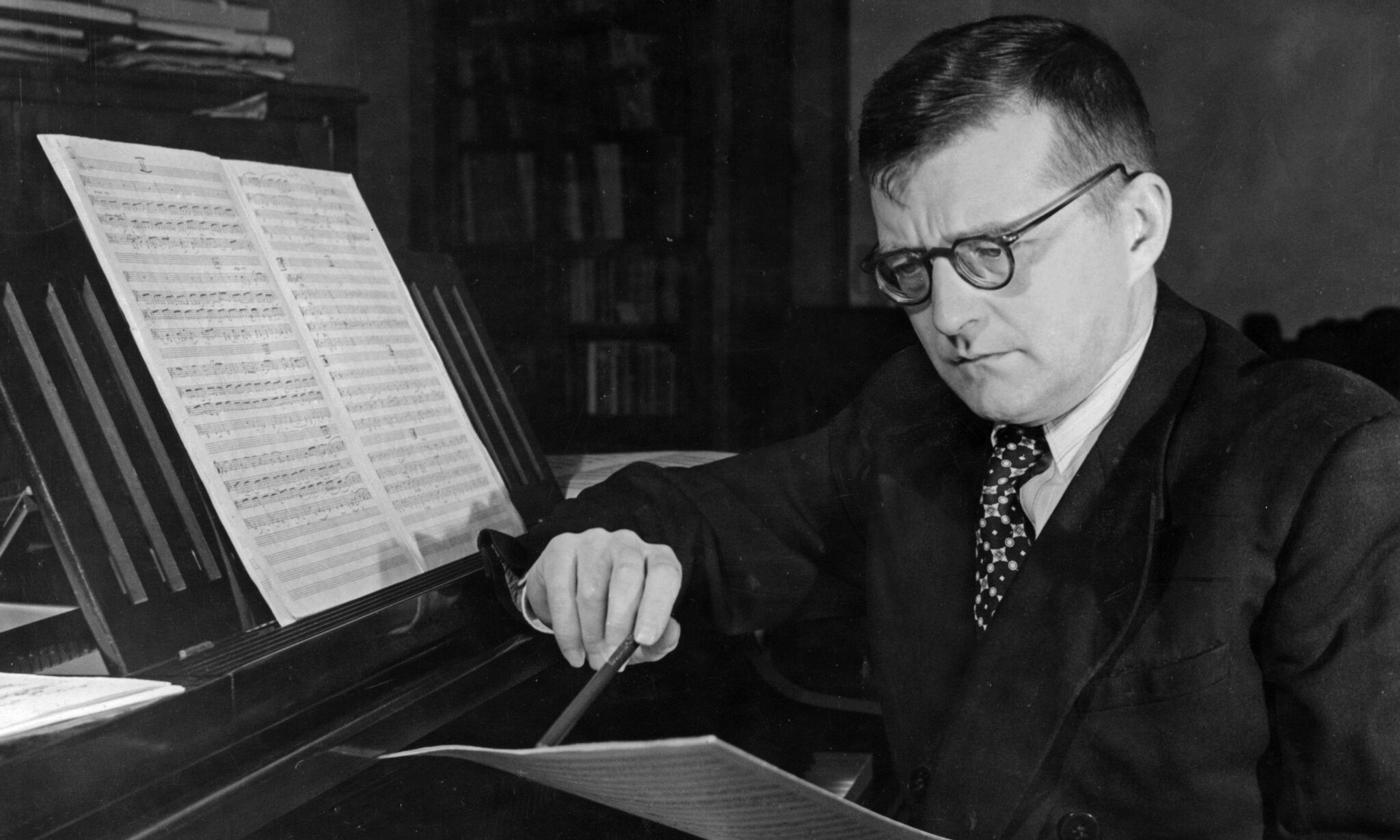
2MBS Fine Music Sydney will commemorate the 50th anniversary of the death of Dmitri Shostakovich on 9 August 1975 with a special series of programs in June, July and August. The programs will feature Shostakovich’s vast output of 15 symphonies and 15 string quartets, culminating with a broadcast of his Symphony No. 13 ‘Babi Yar’ on the anniversary day. The series will showcase the composer’s mastery of large-scale forms in his epic symphonies. In the intimate string quartets, we catch a glimpse into his inner world.
According to Professor Pauline Fairclough of the University of Bristol, a cultural historian specialising in music of the Soviet era, particularly Shostakovich, in terms of reputation Shostakovich has aged much better than Arnold Schoenberg and the Second Viennese School, who were considered by music historians as the key composers of the 20th century, but whose importance has faded in the 21st century.
‘A quick look at listener comments and listening stats on YouTube makes that very clear indeed; and the online picture is replicated in concert [halls] and opera houses worldwide,’ writes Fairclough.
More than 800 European performances of Shostakovich’s works have either already taken place or are scheduled for the 2024/25 season. In May 2025 at the Shostakovich Festival in Leipzig, the Gewandhausorchester (the world’s oldest civic symphony orchestra) performed the composer’s complete symphonies and string quartets.
Fairclough writes that for many years the Western cultural elite sneered at Shostakovich, with French composer and conductor Pierre Boulez describing him as the ‘second or third pressing of Mahler’ and saying he could not take his music seriously.
‘Even his compatriot Igor Stravinsky could not resist patronising him when they met in Moscow in 1962. He was unable to see Shostakovich in any other light than that of an entirely compromised, stylistically regressive composer, stuck in an oppressive state of unfreedom,’ writes Fairclough, adding that both Schoenberg and Stravinsky composed some magnificent music, but it is Shostakovich whose reputation has continued to shine brightest in the 21st century. ‘Mind you, Shostakovich venerated Stravinsky’s music. Let’s not conclude that he wasn’t equally great in his own way – they are both wonderful composers. Shostakovich is just more popular with listeners.’
With many Russians struggling with the changed image of their nation at home and abroad, writes Fairclough, they cling to Shostakovich as a compatriot who displayed great courage and integrity in the face of state terror. Shostakovich detested ‘Great Russian chauvinism’ — the idea that Russia was in some way ‘first among equals’ in the former Soviet Union.
‘He was completely intolerant of that kind of bigotry and also made no secret of the fact that he found antisemitism morally repellent. I have no doubt at all that he would have been horrified by what is happening in Russia today. He was a strongly political person and did make some powerful statements such as his Symphony No. 13.’
Shostakovich composed his Symphony No. 13 ‘Babi Yar’ in B flat minor opus 113 in 1962 in response to the poem ‘Babi Yar’ by Yevgeny Yevtushenko. Babi Yar is a ravine on the outskirts of the Ukrainian capital of Kyiv, which was then Soviet territory. It is the site of the mass murder of nearly 34 000 Jews by the Nazis over the course of two days in September 1941. Yevtushenko wrote his explosive poem in 1961, criticising Soviet antisemitism and indifference to the Nazi massacre; at the time there was no monument at the site.
In his controversial but reliable memoir, Testimony, Shostakovich writes: ‘But we must never forget about the dangers of anti-Semitism and keep reminding others of it, because the infection is alive and who knows if it will ever disappear. That’s why I was overjoyed when I read Yevtushenko’s ‘Babi Yar’, a poem which astounded me. It astounded thousands of people. Many had heard about Babi Yar, but it took Yevtushenko’s poem to make them aware of it. They tried to destroy the memory of Babi Yar, first the Germans, and then the Ukrainian government. But after Yevtushenko’s poem, it became clear that it would never be forgotten. That is the power of art.’
The Soviet regime tried desperately to prevent the premiere of the Symphony No. 13, knowing that an outright ban would only make it a cultural martyr. The first performance took place on 18 December 1962 in Moscow, but not before the regime had placed considerable pressure on the musicians. On the day of the premiere the conductor, Kirill Kondrashin, was asked to take a phone call from the Minister of Culture, Georgi Popov, during the final rehearsal.
Kondrashin recounts the tense exchange:
It was Georgi Popov, the Minister of Culture.
‘Kirill Petrovich, how is your health?’
‘Very well’, I said.
Then a menacing tone was introduced.
‘Is there anything that might prevent you from conducting tonight?’
‘No, I’m in splendid form.’
Then he said, ‘Do you have any political doubts in relation to Babi Yar?’
I answered, ‘No, I don’t have any. I think that it’s very timely and very relevant.’
Silence again. Then he said, ‘Tell me your expert opinion, can the Symphony be performed without the first movement?’
I said, ‘That is entirely out of the question. Everybody already knows that the first movement is a setting of ‘Babi Yar’; if we cut it out it will cause a most undesirable reaction.’
Silence again.
Then he said, ‘Well, do as you see fit.’
Symphony No 13 is only one of the composer’s memorials to the countless victims of terror and tyranny. ‘The majority of my symphonies are tombstones,’ writes Shostakovich in Testimony. ‘Too many of our people died and were buried in places unknown to anyone, not even their relatives. I’m willing to write a composition for each of the victims, but that’s impossible, and that’s why I dedicate my music to them all.’
Shostakovich, writes Fairclough, managed to speak for his compatriots as they lived through terrible personal loss and fear. ‘He suffered with them and could put some of those feelings into music. He was treasured for this, perhaps more than any composer, in any country, of any epoch, has ever been. Even in countries like Australia, who have never experienced totalitarianism, listeners feel empathy with this.’
Shostakovich composed music of colossal emotional power under the most extreme circumstances. He wrote the memoir of the Russian tragedy of the 20th century and his timeless music of human suffering and survival continues to be as relevant as ever.
2MBS Fine Music Sydney will commemorate the 50th anniversary of the death of Dmitri Shostakovich on 9 August 1975 with a special series of programs in June, July and August.
By Paolo Hooke