
Music is a powerful force that binds the social and natural worlds together to delight the listener in ways that are more than purely physical. To create music is to move sound waves of high and low pressure from a source, shifting molecules as it travels in a harmonic pattern. It is amplified into the social world of time and place. This has been the case since the earliest humans began to mimic or respond to sounds in the world around them and create meaning. Indigenous peoples across Australia, for example, have, over millennia, celebrated birds and other animals native to this country with voice and instruments.
Each emerging musical era defines the social world in place and time and reflects the value the natural world holds. This connection is no more apparent than when composers turn their hand to exploring the world of animals.
Musical observations of the character of species and clever imitations of animal cries have been present in the Western world for at least 500 years. They can be revealed through a narrative anthropomorphising of animal characters such as in Prokofiev’s Peter and the Wolf, where each character is represented by a different instrument. Folk tales and imagined tales are the vehicles for musical invention and narration in Poulenc’s The Story of Barbar the Little Elephant and Stravinksy’s Renard, with its duck, fox, rooster, cat and goat characters.
More direct musical mimesis occurs in Rimsky-Korsakoff’s Flight of the Bumble Bee, which takes the listener on a wild ride, while Josquin des Prez centuries earlier engaged his audiences with crickets in his madrigal El Grillo. Chopin’s Minute Waltz was originally called ‘Waltz of the little dog’. More recently, Alan Hovhaness has brought us the song and movement of the great whale.
Perhaps because of its abundance of tuneful melodies birdsong has been a perennial source of inspiration. We all have our own favourite examples. Ralph Vaughan Williams showcases the lark, Respighi a set of Italian birds and there are swans, nightingales, doves, owls and cuckoos in abundance. Olivier Messiaen went so far as to incorporate transcriptions of birdsong into two of his works in the mid-20th century.
Some contemporary composers have taken the path afforded by increasing technological sophistication to incorporate directly not just transcriptions but recordings of birdsong rather than imitating sound and movement. Einouhani Rautavaara recorded the notes of cranes and whooper swans from beyond the Arctic Circle into his Cantus Arcticus, while Australian composer Corinna Bonschek picks up the songs of birdlife in Centennial Park for her work Into the Labyrinth.
Generally, access to the sounds and movement of individual animals is easily attained through observation in a domestic or farmyard setting. However, Saint-Saens’ Carnival of the Animals, his ‘Grand Zoological Fantasy’, is an eclectic collection of both domestic and exotic animals created from within the playfulness of his mind.
Saint-Saens would no doubt have observed the behaviour and character of hens and roosters, swans and, perhaps, fish in an aquarium, during his everyday life in Paris. The cuckoo he attributes to his ventures into the deep woods, but surely his observation of the lion, Tibetan asses, the tortoise and the kangaroo must have come from visits to a zoo, possibly the nearby Ménagerie du Jardin des Plantes where a rich diversity of animals was gathered after the dissolution of the private zoo at Versailles following the French Revolution.
The animals’ antics served as a spectacle for the public and afforded a glimpse into worlds that would have been unreachable by all but the privileged few while also giving scientists the opportunity for research into diverse species in a centralised location.
This early conception of zoos as ‘spectacle’ has evolved exponentially since then. Each zoo can be celebrated for its location in a place that reflects a kaleidoscope of the natural world and contemporary understanding of human history and culture.
Zoos have redefined their mission from showcasing the exotic into centres of conservation for endangered species. Sydney’s Taronga Zoo is one such centre. It has its share of traditional species – lions, giraffes, gorillas, meercats, flamingos and many more. They sit alongside an extensive lineup of iconic species native to Australia: koalas, kangaroos, emus, platypus, reptiles, quolls, to name a few. The zoo houses a veterinary hospital to treat injured and displaced wildlife and researches habitats and native animal behaviour to maximise genetic biodiversity.
It’s time to take a trip to Taronga Zoo now through music, exploring its sense of place and history and its fascinating inhabitants. Perhaps the trip is made on a holiday afternoon in the summer. The sense of place emerges through the zoo’s location on lands traditionally owned by the Kameraigal people on the northern shore of Sydney Harbour.
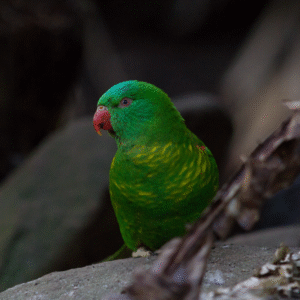
Gurrumul Yunupingu brings back these ancient times with some of the music of the traditional custodians. Since the 1870s, visitors have reached this beautiful location by travelling across the harbour in the ferry. The working harbour evolved soon after colonisation and produced its own soundscape, which still lingers today. Miriama Young takes us there with her Time and Tide, Echoes of Sydney Harbour. When we arrive we can enjoy the presence of elephants, snakes, lorrikeets and spiders thanks to Wilder, Hatzis, Loader and Roussel.
For more than a century, animals have been able to observe the changing activities of the industrialised human world while being observed themselves. When their eyelids begin to grow weary, they can drop slowly off to sleep to the sound of music written just for them: the Lullaby for the Residents of Taronga Zoo by Graeme Koehne.
You can hear these works on 2MBS Fine Afternoons on Friday 20 June at 1pm.
By Heather Middleton