
Non-classical genres
Written and photographed by David Edmonds
The World Record Club (WRC) issued a wide range of non-classical recordings throughout its history. This article explores some of these genres, drawing on examples from a much larger catalogue of releases.
Early Releases
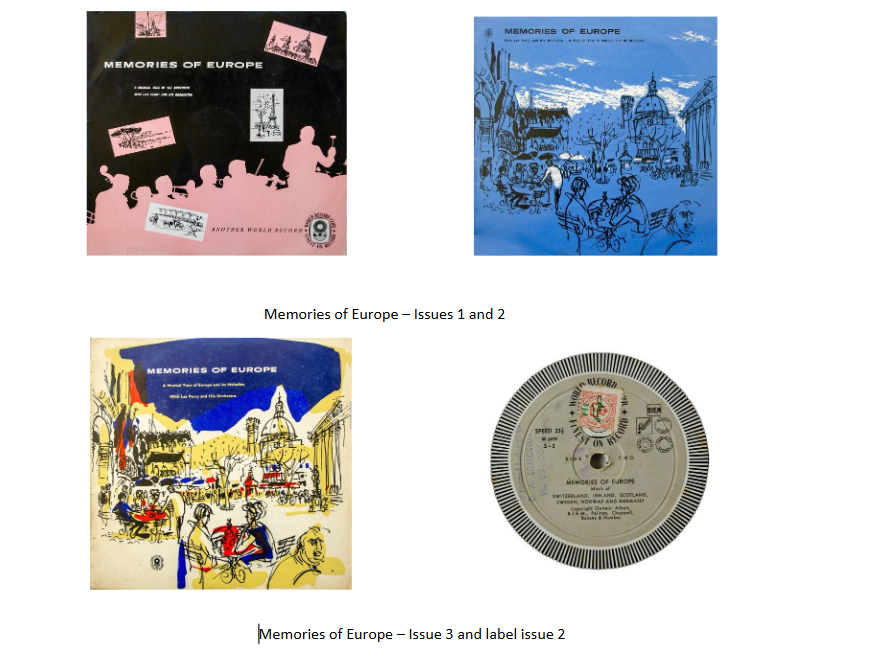
One of the earliest examples of classical “arrangements” was Memories of Europe, performed by Les Perry and his orchestra. The album appears to have been particularly popular, as it was reissued twice. Each of the three editions featured distinct artwork, while the second and third releases included revised liner notes differing from the original.
An intriguing detail is that title ownership is explicitly listed on both the label and for each individual track across all three editions.
The second release also carried a label indicating a royalty of 3s 5/8d (pennies), presumably per LP. By comparison, a later Vanessa Lee Operetta Highlights disc was priced higher, at 5s 7/8d per LP.
Other Early Releases
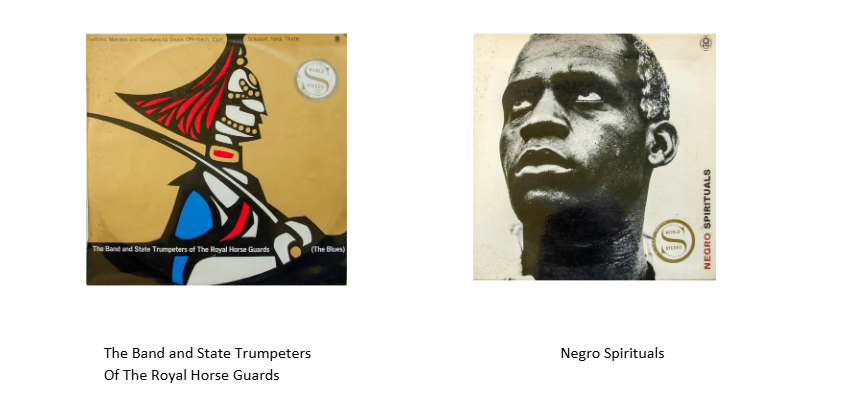
Other early releases included band arrangements by the Band and State Trumpeters of the Royal HorseGuards of popular classics by Elgar, Verdi, Offenbach and others and Negro Spirituals, produced by Cyril Ornadel and released with a fold cover and double inner cover notes.
Light music, crossovers and classical arrangements
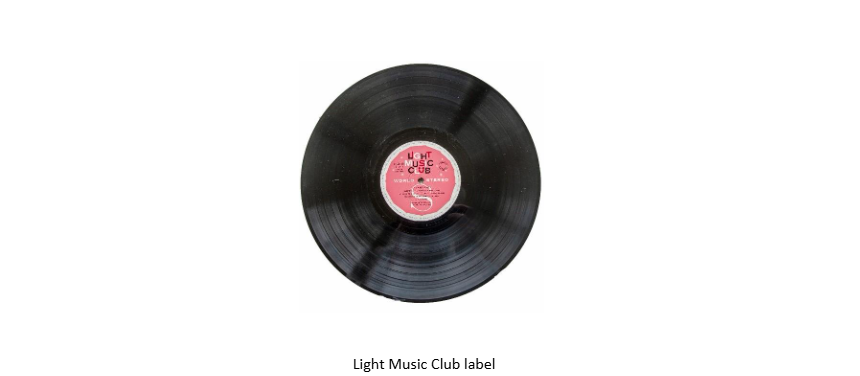
As mentioned in the previous article, WRC established a separate Light Music Club (LMC) label lasting to the end of 1962 but after that reverted to the normal WRC label. The releases described for all genres hereon are from all periods of the WRC.
There were numerous recordings of light music, of which the selections below are only a small sample. These included more multiple source recordings than the classical repertoire.
Mainstream sources of these were Argo, Capitol, Columbia, Decca, EMI, Erato, HMV, Pathé Marcconi, RCA, Verve and more specialist sources such as A&M, ASV, Caedmon, Capitol de Mexico, Dunhill, F.C.M., Greek Columbia, Impulse and WRC (UK).
Popular Vocal and Crossover Releases
WRC released various records of the then popular King’s Singers, among them an album of light songs from recent decades, including the Beatle’s ‘Ob-la-di, ob-la-da’.
Another album was the King’s Singers singing the lyrics and music of Noel Coward and Flanders and Swan on a single LP.
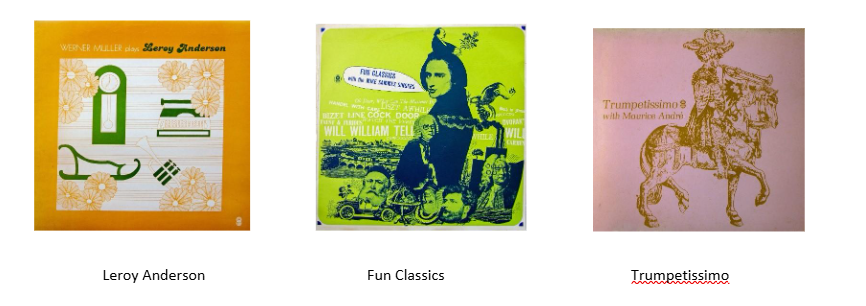
An album of arrangements simply entitled Germany contained German drinking songs, 30s songs such as ‘Lili Marlene’ and ‘Mack the Knife’ (Threepenny Opera) and the Huntsman’s’ chorus (Der Freischütz) and Ride of the Valkyries (Die Walküre). These were played by Werner Muller and his orchestra, who were also the artists featured on an LP of Leroy Anderson’s favourites.
Another Cyril Ornadel production featured the Mike Sammes singers in Fun Classics, with wordless singing arrangements of music by Verdi, Handel, Rossini and others.
The songs had corny titles such as ‘Watch the Verdi’, ‘Carmen get it’, ‘Bach to Front’ and ‘Oh dear, what can the Massenet be’. One of the crossover releases featured 1960s virtuoso trumpeter Maurice André playing light classics, backed by organ, drums and double bass.
Operettas and musicals
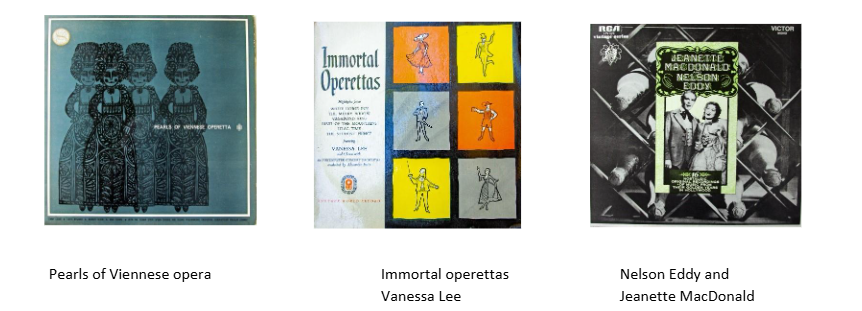
As well as complete musicals, WRC released LPs of highlights, featuring such artists as Emmy Loose and the Vienna Philharmonic, Vanessa Lee and favourites of the 1930s musical movies, Nelson Eddy and Jeanette MacDonald.
Vocalists
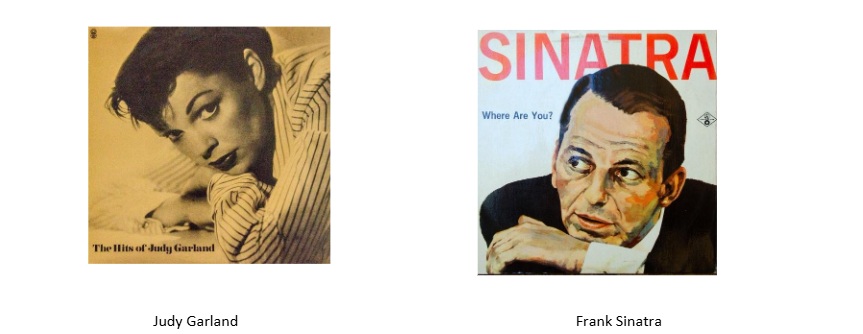
The late 50s, 60s and 70s were high points of bestselling vocalists such as the Beatles, Rolling Stones, Tom Jones, Shirley Bassey and crooners like Frank Sinatra, Perry Como, Dean Martin and many others. These artists featured on primary labels such as Decca, Parlophone and Capitol and their LPs sold through normal retail outlets. Nevertheless, with access to the US Capitol label, WRC issued LPS of some major vocalists such as Judy Garland and Frank Sinatra.
A three-volume issue of Frank Sinatra was released in later years but another earlier LP release, Where are you?, featuring ‘Old Blue Eyes’ (with the cover drawing showing distinctly brown eyes), was released in 1968.
Folk
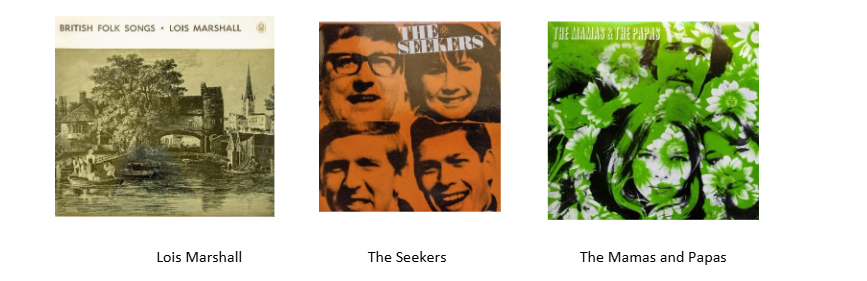
Folk song releases varied from the staid traditional English songs sung by Canadian opera singer Lois Marshall though to the 60s-style The Seekers and Mamas and Papas.
Jazz and Latin
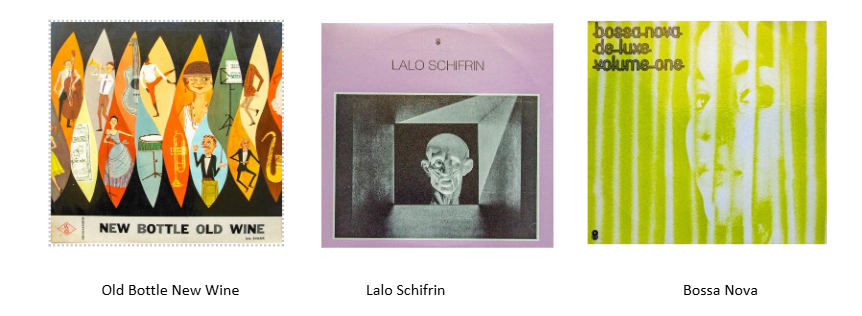
LMC released a number of jazz LPs, each with the same cover. An early release, titled New Bottle Old Wine, featured Cannonball Adderly and the Gil Evans Orchestra. Tracks included W.C. Handy’s ‘St. Louis Blues’ and ‘Struttin’ with some Barbeque’, by Louis Armstrong, which won the London News-Chronical Award as the best jazz record of 1959. Another release at the time was Wild about Harry, featuring Harry James and his orchestra.
Other jazz records released over the years included the work of Laurindo Almeida, Lionel Hampton, versatile musician Lalo Schifrin and, in 1977, Trad Jazz in Australia featured various Australian bands. A couple of Bossa Nova records featured Laurindo Almeida, Sergio Mendez and many South American artists.
Hits of the decades
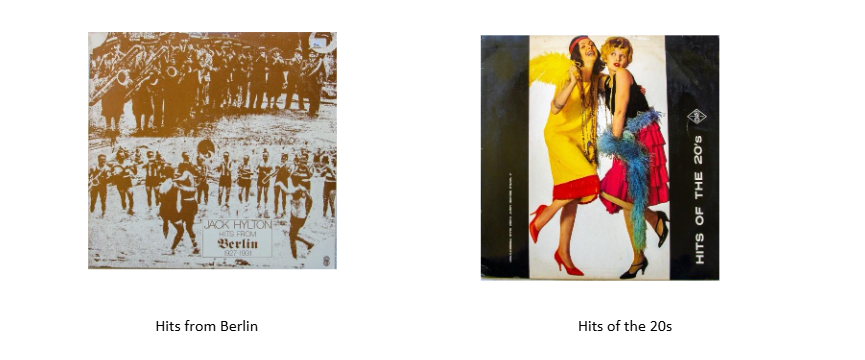
Two Cyril Ornadel productions on LMC were Hits of the 20s and Hits of the Thirties. The 20s album included ‘Red Red Robin’, ‘Yes, we have no bananas’ and ‘California’, among others. Among the songs on the 30s album were ‘I’m gonna sit right down’, ‘Blue Moon’ and ‘Thanks for the memory’. Singers included Benny Lee, Jean Campbell, Barbara Brown and an orchestra under Ray Terry.
An interesting WRC (UK) compilation was Hits of Berlin 1927-1931 – restored tracks from 78s, made by a British band led by Jack Hylton and vocalists Austin Egen, Sam Browne, Marcel Wittrisch and Pat O’Malley. Most of the tracks were recorded on tours to Paris and Berlin, the others in London. Pieces included Lehar’s ‘Heut’ war ich bei der Friede’, Krausz’s ‘Handsome Gigolo’ and selections from Benatsky’s White Horse Inn.
Film music
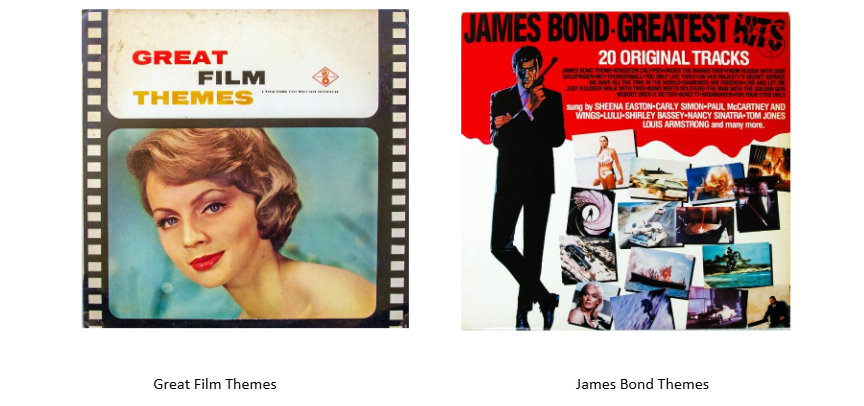
A Cyril Ornadel production of Great Film Themes was another early LMC release. This featured the usual Ornadel stalwarts, John Adams, Andy Cole and Barbara Leigh, with tracks from then contemporary films such as ‘True Love’ from High Society, ‘Tammy’ from Tammy, ‘Gigi’ from Gigi and ‘Around the World’ from Around the World in 80 Days. The sleeve note did not beat around the bush in describing the merits of the disc – ‘This is one of Light Music Club’s finest presentations to date … It is also a superb production, beautifully orchestrated and performed with unreserved vigour and joy.
Other film music released over the years was a Decca sourced Film Spectacular of 1960s film themes such as Zorba the Greek’, various (early) James Bond movies and The Sound of Music, performed by Stanley Black and the London Festival Orchestra. A 1982 EMI-sourced LP of James Bond’s Greatest Hits, with 20 original tracks, was released with a simple WRC oversticker.
World music
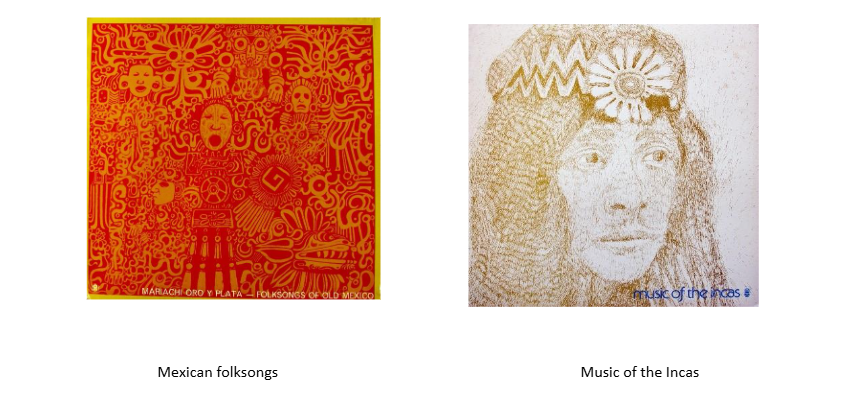
While most of the music I have written about has been Western in origin, music is made by numerous cultures and releases included Folksongs of Old Mexico, performed by Las Hermanitas Salvidar, and Music of the Incas. The latter was performed by un-named musicians, playing post-Spanish Inca period flutes, harp and guitars. (To my ears, although the instruments might be old or suitable reproductions the music itself sounds fairly Western-based pop.)
Concert and music hall
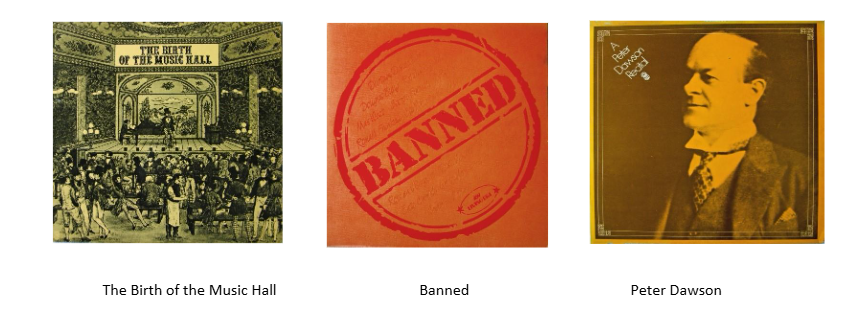
These songs were from both modern recordings and restorations of 20s and 30s shellac 78s. A modern recording, The Birth of the Music Hall, included ‘Champagne Charlie’, ‘Pretty Polly Perkins’ and ‘The Rat Catcher’s Daughter’. Three LPs were issued under the Retrospect label and title, Laughter Unlimited, including numerous songs and artists recorded in the late 20s and early 30s. Artists included Gracie Fields, Stanley Holloway, Max Miller, Sophie Tucker and George Formby.
A late issue in 1985, released by WRC New Zealand, was Listen to the Banned, an ASV compilation of risqué songs (now sounding very bland), recorded in the 20s and 30s. The tracks featured artists such as Mae West, Sophie Tucker, Max Miller, Art Fowler and Gertrude Lawrence.
Special mention should be made of Australian baritone Peter Dawson (1882-1961), whose career and repertoire extended from opera and oratorios through to the concert hall and included light music and ballads. His first record on wax was made in 1904, his last in stereo in 1958. In 1976 WRC released an album of a recital compilation of ballads, originally recorded in mono for HMV. These included Australian pieces such as ‘Waltzing Matilda’, ‘The Bushrangers’ and ‘Clancy of the Overflow’. Also included was a Dawson signature piece, ‘The Road to Mandalay’.
Christmas
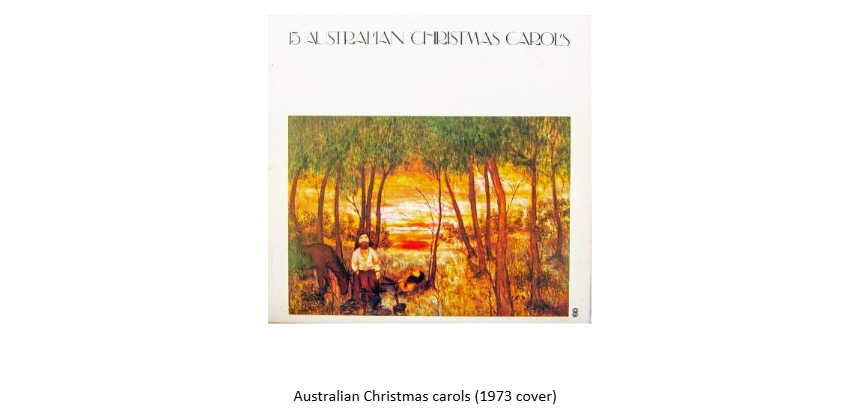
An early 1961 release was an LP of 15 Australian Christmas carols, composed by William James, with text by John Wheeler and sung by the NSW State Conservatorium choir. Sir Bernard Heinze conducted the Sydney Symphony Orchestra in these wonderful settings.
Spoken literature
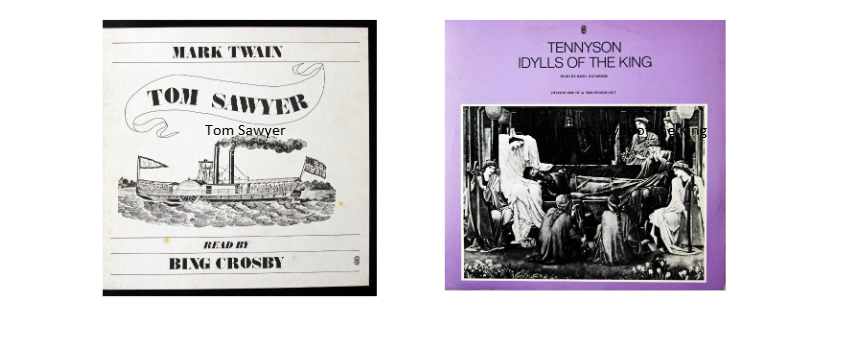
A number of non-musical works were issued over the years. Prominent was a three-LP set of Churchill’s speeches, titled The years of Challenge. Others were a two-LP boxed set of an abridged version of Mark Twain’s Tom Sawyer, read by Bing Crosby, with music by Tommy Reilly and two separate LPs of golden-voiced actor Basil Rathbone reading Tennyson’s Idylls of the King.
Miscellaneous
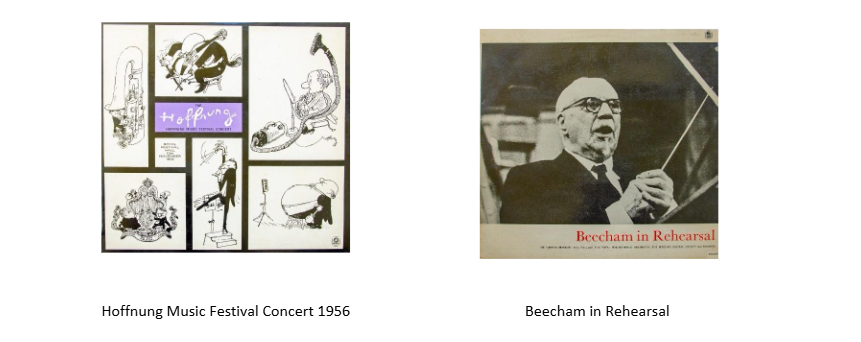
Too difficult to classify were issues of the three Hoffnung Music festival concerts (1956, 1958 and 1961). Hoffnung’s cartoons were famous for their musical connotations. He died tragically in October 1959. The first concert in November 1956 included the commissioned ‘Grand Grand Overture’ by Malcolm Arnold, Dennis Brain playing the third movement of Leopold Mozart’s horn concerto and the second movement of Haydn’s 94th symphony, with even more surprises. The subsequent concerts were in similar vein. For example, the 1959 Hoffnung Astronautical Music Festival included the Leonore Overture No 4. The LPs were originally issued as three individual LPs in 1963, 1963 and 1965 and subsequently re-released as a boxed set in 1978.
Beecham In Rehearsal came out concurrently with the release of the 12 Haydn London Symphonies, conducted by Sir Thomas Beecham and played by the Royal Philharmonic Orchestra. The first side comprised Beecham anecdotes, interspersed with rehearsal extracts from three of the symphonies. The second side was a more in-depth rehearsal of Mozart’s Die Einfühlung aus dem Serail, including a stunning ‘O, wie will ich triumphieren’ from bass Gottlob Frick.
Conclusion
The examples I have given in this series of articles represent a small proportion of the range and depth of music repertoire of the WRC. Undoubtedly the purchase of their LPs provided the basis of then and future live and recorded listening pleasure for the Boomer generation. Provision of (usually) good sleeve notes and texts and translations of song and opera was taken for granted. While vinyl has made something of a comeback in the pop field there are only token issues of classical LPs, at least in Australia, as direct downloads are far more viable.
WRC was terrific in its time, a period unfortunately not likely to be repeated.
History of WRC
World Record Club UK and Australia
Please click HERE to read part 1, 2,3,4,5, and 6
References
Personal LP collection
John Xuereb collection
Shirley Cox collection
Wikipedia
Discobs – LP details and history. including individual tracks are found on this website