
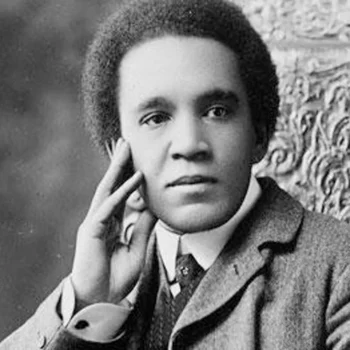
Samuel Coleridge-Taylor was born on 15 August 1875 in London, the son of an English woman and a Sierra Leonean man. His father, a medical student, returned to Sierra Leone upon graduating, unaware that he had fathered a child. Coleridge-Taylor was brought up by his mother and her extended family, who recognised his musical talent.
From 1890 he attended the Royal College of Music, initially as a violinist but graduating in composition and conducting. His composition teacher was Charles Villiers Stanford, who regarded him as one of his most brilliant students. During this time he composed piano and clarinet quintets and other, mostly chamber, works, and won the Lesley Alexander composition prize twice. Having experienced incidents of racism both at school and at the RCM, he was insecure and shy but was fortunate to be able to study in an environment that recognised and furthered his abilities.
In 1898 his cantata Hiawatha’s Wedding Feast was premiered to a rapturous reception from critics and public alike. Choral music was inclined to be religious or serious and this work was regarded as a breath of fresh air. It was described as ‘a big, lovely orchestral sound buoying up the excitement of a massed bank of voices singing a melody which flowed more or less continuously’.
Its success brought many commissions for further cantatas (including two sequels), none of which had quite the same impact. Nevertheless, the Hiawatha trilogy was staged at the Royal Albert Hall every year from 1924 until the outbreak of World War II: families would come to hear it dressed ‘in fancy dress with feather headdresses, embroidered tunics, and their hair in plaits’. By this time Coleridge-Taylor had become increasingly aware of his heritage. He had been entranced by the spirituals of the visiting African American Fisk Jubilee Singers and had met the African American poet Paul Laurence Dunbar. These influences were incorporated into numerous compositions.
‘What Brahms has done for the Hungarian folk music, Dvorák for the Bohemian, and Grieg for the Norwegian, I have tried to do for these Negro melodies,’ he wrote. He visited the United States three times and was fêted there. African Americans had only been freed from slavery in the 1860s and Coleridge-Taylor’s achievements, rare among people of African origin in the West, were a model to which they might aspire if they were permitted entry to musical institutions.
New York orchestral players dubbed Coleridge-Taylor the ‘African Mahler’ in acknowledgement of his conducting abilities. In compositional terms, however, the melodic and rhapsodic traits of Dvorák are a more appropriate comparison and can be discerned in his last major work, the Violin Concerto. It was premiered in Connecticut in June 1912, but the composer was unable to attend. He died of pneumonia in September that year; his funeral featured a wreath in the shape of Africa, sent by the ‘sons and daughters’ of West Africa resident in London.
Listen to Sunday Special, The Music of Samuel Coleridge-Taylor on Sunday 17 August at 3pm
Reviewed by Paul Cooke