
Meg Matthews
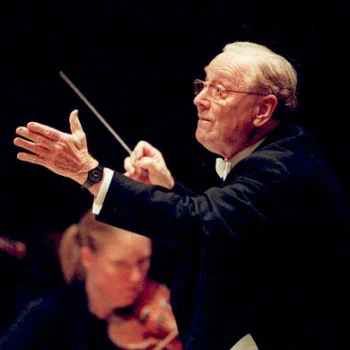
Most music loving Australians will have heard of Charles Mackerras, his conducting, arrangement and promotion of Czech music (especially that of Janáček), but how did it all happen?
Catherine Mackerras was a matriarch in the fullest sense of the word. She had great affection and admiration for her forebears, especially her grandfather Sir Normand MacLaurin (Chancellor of Sydney University), her father, Dr Charles MacLaurin, and her seven children, of whom Charles was the eldest.
Catherine, born in 1899, was an only child and precociously intelligent. With an imaginative, curious mind, she was fascinated by words and ideas and, like her father, was musical. In 1963 she wrote the biography of her great-great-grandfather which she called The Hebrew Melodist and subtitled ‘A life of Isaac Nathan, Father of Australian Music’. At Sydney University she had majored in History and, although her result was proxime accessit (runner-up) to Victor Windeyer, who would become a judge, her professor told her: ‘Your paper was as good as his but … [the University medal] is more useful for a man.’ Understandably, Catherine never forgot this remark.
She met Alan Mackerras in 1920, probably at Palm Beach, where, with a group of friends, they enjoyed fishing, sailing swimming, and bush walking, ‘interspersed with lighthearted literary diversions’ to which they all contributed. Alan’s sailing skills were much appreciated by the group.
Alan also had a lifelong interest in astronomy, describing Antares as ‘the most beautiful star in the sky’. Much, much later, when he invited my husband Stephen and me to go sailing, the yacht we sailed in was his beloved Antares, which he maintained meticulously. Only some of their seven children shared his passion for sailing, but ‘Charlie’ was one.
Alan and Catherine were married in April 1924 and within weeks sailed for the United States, where Alan spent the next three years with the General Electric Company in the state of New York. Catherine wrote regularly to her beloved father and early in 1925 shared the news that she was expecting their first child. But sad news awaited her – he had collapsed and died and their letters had crossed. Tributes to him flowed in both Australia and America and she enjoyed the phrase ‘His scalpel may have been skilled, but his pen was inspired’.
Alan Charles was born on 17 November 1925 in Schenectady US, amid much rejoicing. Eighteen months later, in 1927, Alan and Catherine left America with their Charlie and travelled back to Sydney, settling in the home in Vaucluse that had been her parents’ wedding gift to the young couple.
In 1928 their second son, Alastair, was born. Catherine, who was finding the Presbyterian church ‘rent with modernism’, embarked on a spiritual journey, moving to the Anglican Church of St Michael’s Vaucluse. It was here that Charlie made the now famous observation that the hymn ‘Onward Christian Soldiers’ reminded him of The Gondoliers by Gilbert and Sullivan. As Sullivan had composed the well-known hymn, Catherine told me that was when she realised Charlie was a genius. A long-term friend of Alistair, John Parkinson (now a prominent Sydney psychiatrist), recalls that ‘Mrs Mackerras was the most marvellous encouragement to her children, right from their early years’. But she was also a very dominating force in both her behaviour and her opinions.
When Catherine Mackerras made the divisive decision to be received into the Catholic Church she and Alan reached a compromise agreement: their children would attend Catholic primary schools and Protestant secondary schools. Charlie went first to St Aloysius where he excelled in various Gilbert and Sullivan roles, including the role of Ko-Ko in The Mikado, in which he reportedly ‘stole the show’.
Charlie’s second brother, Neil, was born in 1930 and Charlie was sent to stay with his grandparents. They had a wind-up gramophone and a complete set of Gilbert and Sullivan plus music by Beethoven and Wagner, to all of which he listened avidly, observing later that ‘I suppose it was then I began to realise I was musical.’
In January 1934 the first Mackerras daughter, Joan, was born. She attended Loreto Convent Normanhurst and then PLC Pymble and became a professional violinist and music scholar. As an adult living in England at the same time that Charlie and his wife lived in London, Joan helped Charlie (whom she adored) with his scholarly research into 18th-century music. Her sister Elizabeth, born in 1937, became a ballet dancer and the family was completed with the arrival of the twins, Colin and Malcolm, in 1939. By this time the growing family had moved from Rose Bay to a house they had built in Turramurra. Catherine had one rule for her large and lively brood: ‘You must not quarrel!’ According to Alistair, the result was that ‘none of us are any good at fighting’.
Catherine arranged violin and piano lessons for Charlie at the local convent in Pymble. He was becoming completely obsessed with music and decided to give a concert at their home. A guest, Professor David Myers, a colleague of Alan, who attended, recalled:
We were invited to hear a performance by a children’s orchestra, conducted by his eldest son Charles, playing some of his own compositions. He had two or three of his brothers or sisters in the orchestra … and his compositions were clearly influenced by Mozart.
At about this time, Charles read in The Sydney Morning Herald that there was a shortage of oboe, horn and bassoon players in Sydney and determined as he was to become a professional musician, this seemed a quick way to join an orchestra. So, although he was already learning the flute, he switched to the oboe, while continuing his piano lessons at the Conservatorium, where he spent most of his free time. His parents, both successful university graduates, had assumed that he would study for a degree, but he had other
ideas. He was moved to Kings as a boarder but hated the regimentation and ran away several times, finally being expelled.
In 1939 war was looming but Charles Mackerras was conducting and composing. He wrote an opera and a cantata in the style of Handel, for which his mother wrote the libretto. During the war Catherine kept a Jersey cow, ducks and chickens and grew vegetables on the family’s half-acre plot. Joan remembers that the children’s favourite homegrown vegetable was sweetcorn.
Charles joined the ABC orchestra (forerunner of the Sydney Symphony Orchestra) as second oboe in 1943, becoming principal in 1944. Three years later he sailed for England, where he auditioned for the BBC Symphony Orchestra. He was not appointed but was encouraged by Sir Adrian Boult. Undaunted, he auditioned more successfully for the Sadler’s Wells Orchestra (SWO), where he was appointed second oboe, cor anglais player and repetiteur.
In 1947 he married Judith Wilkins, a clarinettist in the SWO, who he described to his mother as ‘exactly the type of girl I know you like … she has a lot of brains and common sense, a sweet disposition and tons of humour … and has had a very fine education’. She was certainly going to need all those qualities for marriage to a man who was so single-minded. In the same year Charles was awarded an Anglo-Czech scholarship to study in Prague.
He and Judy organised a hasty wedding, had some basic lessons in Czech and arrived in Prague, where Charles heard his first Janáček opera, conducted by Václav Talich. It was a life-changing moment. Charles Mackerras went on to become the most celebrated non-Czech conductor to promote Czech music in general and Janáček’s in particular. Meanwhile, he and Judy thoroughly enjoyed the welcome they received in Prague and he returned there many times.
He went on to conduct orchestras in countries as far apart as Sweden, South Africa, Australia and the USA with increasing success but there were some highs and lows in his long career.
His brilliant arrangement of Sullivan’s music for the ballet Pineapple Poll in 1951, which was based on melodies from the Savoy operas, has retained its popularity; he conducted the SSO and selected musicians for the opening festivities for the Sydney Opera House; he was knighted in 1979; he conducted the Last Night of the Proms in 1980; he was Chief Conductor of the SSO from 1982 to 1985 and in 1996 he was awarded the Medal of Merit by the Czech republic. There were many other awards and premieres in major musical centres across the globe. But there were also two tragedies: in June 1987 his granddaughter Alice died of leukaemia and in September 2006 his daughter, Fiona, died of cancer.
Sir Charles Mackerras died of multiple myeloma on 14 July 2010 and his funeral was held in St Paul’s Cathedral, London. In his address to the congregation the Rector of St Paul’s, the Reverend Simon Grigg, said: ‘I’d like, in the tradition of opera, to give Sir Charles a standing ovation.’ For more than a minute there was thunderous applause in that resonant cathedral.
Charles Mackerras would have been 100 this month.