
By David Brett
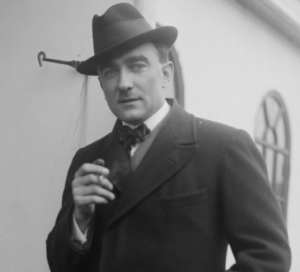
Asked to list Polish composers, most people would come to a grinding halt after Chopin. Perhaps, given the history of Poland over recent centuries, it is understandable that Poles would have focused more on survival rather than on creating music. After all, even Chopin produced his greatest work after he had left Poland for Paris.
However, there is at least one other Polish composer of the Romantic era who deserves to be better known. He is Karol Szymanowski, whose life was the reverse of that of Chopin. Born in 1882 into a wealthy family of Polish nobility, Szymanowski learnt the piano early and, after his formal education, studied for four years at the Warsaw Conservatory.
He was not interested in Polish music, whether folk or modern. His early influences were rather the cutting-edge modern Europeans: Strauss, Debussy, Stravinsky and, a particular favourite, Scriabin. Having the resources to do so, he spent the years between graduating from the Conservatory in 1905 and the outbreak of war in 1914 travelling extensively. He stayed for lengthy periods in Berlin and Vienna, toured Italy, Sicily and Greece and travelled widely through the Arab world in North Africa and the Middle East.
Szymanowski loved the ancient culture of the Mediterranean and his compositions became heavily romantic, creating an opulent sound world full of yearning melodies and filigree decoration. As a critic wrote: ‘If any music could be said to be heavily perfumed, it’s Szymanowski’s!’ Perfect examples are his First Violin Concerto and his Third Symphony, both completed in 1916. The concerto is based on a poem entitled ‘May Night’, which is a fervent evocation of love amid the richness of nature, while the symphony is subtitled ‘Song of the Night’ and was inspired by the mysticism of a 13th-century Persian poem.
The First World War and the Russian Revolution changed everything. Szymanowski’s family estate was destroyed by the Bolsheviks in 1917 and the family was ruined. He was unable to compose for some years. However, out of the chaos, an independent Poland emerged in 1921. Szymanowski returned home and, together with other Polish intellectuals, sought to create anew a truly national art.
Being a pianist, his first thought was the legacy of Chopin (whose direction of travel he had now reversed) and he began to write mazurkas. Though he composed in his own style, he could not see this path as productive: ‘Poland’s national music should not be the stiffened ghost of the polonaise or mazurka’. A meeting with Stravinsky in the early 1920s, however, showed him how folk music elements could be used in a completely unsentimental way, thus overcoming the limitations he had seen.
In the late 1920s Szymanowski divided his time between Warsaw, where he became Director of his alma mater, the Warsaw Conservatory, and the Tatra Mountains in southern Poland, where he absorbed local folk music. His most ambitious attempt at using that music in symphonic form was Harnasie, written between 1927 and 1931. Described as a ballet-pantomime and scored for solo tenor, chorus and massive orchestra, it tells the tale of a peasant bride-to-be who is abducted by the outlaw, Harnas, and his followers, the Harnasie.
Other works from this time include the Symphonie Concertante for piano and orchestra and the Second Violin Concerto, both of which use folk music characteristics, with the second concerto differing radically in style from the luscious tones of the first, written 17 years before.
Unfortunately, Szymanowski’s health started to decline with the onset of tuberculosis. His last years were marked by illness, financial problems and neglect of his music. He died at a sanatorium in Lausanne in 1937, aged just 54.
He has, however, come to be regarded as a national hero in Poland. His music has enjoyed something of a revival in the 21st century, championed by some major conductors, including Pierre Boulez and Simon Rattle, and played regularly in concert halls around the world.
Hear the music of Karol Szymanowski on The Life of a Composer with David Brett, broadcast at 8.00pm on Saturday 21 February.