
By Maureen Chaffey
This article first appeared in Fine Tuning
Like many children, I learned to play the recorder in school and loved being able to make music myself and with my classmates. I attended the ‘Enjoy, Learn, Discuss’ talk given by Robert Small at 2MBS on Sunday 5 October 2025 and his passion for recorders inspired me to find out more.
The recorder can be classified as part of the family of vertical flutes. These instruments, which have a particularly ancient history, include the Japanese shakuhachi, the quena, heard in South American folk music and folklore, and a variety of primitive instruments found all around the world.
The most familiar ducted vertical flutes are the recorder, tin whistle and tabor pipe, all of which have a fixed windway formed by a wooden plug or block.
The recorder, which came into being in Europe during the Middle Ages, has been distinguished from other internal duct flutes by its holes for seven fingers and a single hole for the thumb of the upper hand.
Mediaeval recorders
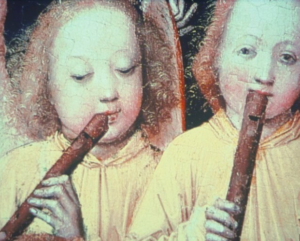
Present knowledge of the shape and structure of recorders from the Middle Ages is based on the few instruments now preserved and on artworks, including iconography, from the period. With a cylindrical bore, their tone is described as bold and characterful.
Making recorders
By far the most important factors determining the sound of a recorder are its design, style, and voicing (fine tuning that determines the instrument’s tone quality, stability and ease of play).
Recorders may be made out of a wide variety of woods and other materials, which vary greatly in appearance and hardness. Different varieties of woods have individual characteristics which tend to favour certain sound qualities. Relatively soft woods, such as maple, pear and other fruit woods often produce a very warm tone but less volume than denser materials.
Very hard woods such as ebony or grenadilla may give an instrument more volume and brilliance and tend to require longer warm-up periods. European Boxwood, which is fine grained and carves beautifully, was the favoured wood for the best early woodwind makers. However, because it is extremely slow growing (a tree large enough to use for instruments may be as much as 300-500 years old), the wood is often full of knots, splits, cracks and other imperfections which make working it quite labour intensive.
The recorder is made in three parts:
- the head joint or mouthpiece where the air is blown
- the middle joint or body with finger holes and the thumb hole
- the foot joint (bottom section), which also has finger holes.
The joints must be absolutely airtight. Any leak will affect the sound quality. The method used to create a tight seal between the instrument’s sections is typically a waxed silk or cotton thread that wraps around the ‘tenon’ (the smaller, protruding part) of each joint.
The bore
When seen horizontally, the interior of the bore of a recorder is not straight, it traces a free curve. If the internal shape of the bore is changed, the pitch of the sound produced also changes even if the length of the bore, the holes, and the way the holes are covered remains unchanged.
The trade of recorder making was traditionally learned via apprenticeship. In the Renaissance period notable instrument makers included the Schnitzer, Bassano and Hiers/Hies families.
The Bassano’s made ‘Instruments so beautiful and good that they are suited for dignitaries and other potentates’ wrote Johann Jakob Fugger, artistic advisor and superintendent of music at the Bavarian Court in about 1560.
The Schnitzers were known for making powerful and solid-feeling recorders and the Hiers/Hies family recorders were more delicate than those of the Bassano family.
The Bassano family
In the early 1500s Geronimo Piva started as an instrument repairer and maker in the town of Bassano, near Venice, Italy. The family became known as the Bassano family.
In 1540 Henry VIII granted places to ‘Alvixus, John, Anthony, Jasper and Baptista de Basani [sic], brothers in the science or art of music’. No fewer than 17 members of the family worked in the English court as musicians and instrument makers during the 16th and 17th centuries and even today their descendants continue to work in the performing arts.
Recorder families comprised many sizes, including large contrabass designs. Large sets were made for royalty and nobility. Henry VIII had 76 recorders.
In the 16th-century instrument makers began producing recorders with cylindrical inner bores and, as the century progressed, the inner bore of the recorder was modified to create a different sound. A ‘choke’ or contraction towards the bottom of the instrument was introduced. The instrument was bored to the smallest diameter, then the inside was enlarged from both ends using reamers, a process that required great skill.
The ‘choke bore’ of the renaissance recorders gradually developed into a conical profile. An inverted cone (contracting towards the lower end) emits lower frequencies than a cylinder of the same length. A choke feature also enabled the use of smaller holes. Instruments could therefore be made shorter and easier to play with virtuosity. The recorder was becoming a solo instrument.
Renaissance recorders have a bold, rich timbre which is even in quality and dynamic level throughout their range. They are ideally suited to the performance of the polyphonic vocal and instrumental music of the late 15th to early 17th centuries, blending blend readily and in balance with each other in whole consorts or contrasting on equal terms with other renaissance instruments or voices.
The Baroque recorder
Until the last decades of the 17th century recorders, apart from the very large ones, were usually made in one piece. Then an important change took place and they started to be made in three parts. The main reason for this new technique was the bore profile, which was becoming increasingly complicated.
Recorders now had a fully chromatic range of two octaves and ultimately two octaves and a fifth. They were voiced to produce an intense, reedy and penetrating tone with considerable carrying power and expressiveness.
While mostly made as single instruments, recorders were also made in families and matched pairs. The most common size was the treble, the ‘trewe concert flute’, which had a sophisticated external and internal form. The exterior was decorated with beautiful turnings with ivory at the joints, beak and bell. It included a tapered bore and curved windways, giving the instrument a sweet sound with range of more than two octaves making them admirably suited to the performance of chamber music and even concertos.
In this form the recorder survived as a professional instrument late into the 18th century and as an amateur instrument some way into the 19th, when it was temporarily and briefly eclipsed by the flute and oboe.
The Chester recorders
In 1886 the Chester Archaeological Society moved into new quarters in the freshly built central ‘Grosvenor’ Museum. Found in the lumber from its old rooms was a peculiarly shaped box (which crumbled to pieces almost immediately). In it the secretary found what he thought to be an ancient bassoon.
‘On viewing the remains, what was my delight to find that the Society was the possessor of a rare set of ancient Flûtes à bec, or Recorders.’
The Chester instruments bear the name of Bressan, under a Tudor rose. Peter Bressan, an English recorder maker, was generally regarded as ‘The Stradivarius of recorder makers’. This was quite a find.
The Dolmetsch family
Towards the end of the 19th century interest in historical instruments revived. Large museum collections of antique musical instruments were assembled and musicians performed on them.
Eugène Arnold Dolmetsch (1858-1940), performer, instrument maker, scholar and promotor, was thoroughly trained as a craftsman at his parents’ piano, organ and harmonium manufactory in France. In 1883 he moved to London to enrol at the newly opened Royal College of Music, where he could further his interest in ‘early music’ and the instruments for which it was written. He began to collect and restore old instruments, make reproductions and produce performances of old works.
George Bernard Shaw wrote of him:
Mr Arnold Dolmetsch has been bringing the old instrumental music to actual performance under conditions as closely as possible resembling those contemplated by the composers. The music, completely free from all operatic aims, ought, one might have supposed, to have sounded quaintly archaic. But not a bit of it. It made operatic music sound positively wizened in comparison.
Dolmetsch set up a factory and began to collect and later make viols, lutes and a range of early keyboard instruments. He played newly discovered works on treasured originals and on his recent reconstructions.
For him the ‘craft’ of instrument making was more than just ‘reproduction’ just as ornamentation in music is more than playing only what early masters committed to print.
Carl Dolmetsch
Carl began his musical career at four, playing the viol, then the violin. He made his debut on the recorder in 1923 when he took part in a performance of Bach’s Brandenburg Concerto No 4. He had learned to play the recorder in only five weeks.
Thus began his lifelong interest in the instrument. After the success of this concert, his father handed over the entire responsibility for recorder production to him even though he was only 15 at the time. Carl was an accomplished performer, independent designer and craftsman and his love of the recorder brought the instrument to a worldwide audience.
His career as a virtuoso recorder player took flight in the 1930s when he formed an historic partnership with Joseph Saxby, pianist, a partnership that endured for 60 years.
Dolmetsch gave more than 40 recorder recitals between 1948 and 1989 and in each he played a new work.
During the Second World War the Dolmetsch workshop was used for the manufacture of parts for aircraft guns. More than two and half million components were produced from vulcanised fibre and plastic materials to a high degree of accuracy.
Carl realised the same technology could be used for recorder production and in 1945 made the drawings for the first Dolmetsch plastic recorders, which rolled off the production line in 1946. They shared the same dimensions as the wooden instruments, so the intonation and tone quality were of a high standard.
Because of their affordability, these plastic recorders were soon introduced into schools, where they revolutionised musical education for generations of children. By the 1950s and 60s, ‘recorder’ had become a household word.
Frans Brüggen
Franciscus ‘Frans’ Jozef Brüggen (30 October 1934–13 August 2014) was a Dutch conductor, recorder player and baroque flautist. He was also a musicologist, deeply in love with original instruments and early sources. He helped to transform the perception of the recorder as a serious musical instrument.
In 1981 Brüggen co-founded the Orchestra of the Eighteenth Century, of which he was the de facto chief conductor for nearly 30 years. In 1992 The Orchestra of the Age of Enlightenment (OAE) named Brüggen its co-principal guest conductor, in parallel with Simon Rattle, and later emeritus conductor. A true pioneer of the early music revival, Brüggen amassed a remarkable collection of historic recorders dating from the 1680s to the 1740s.
Fred Morgan
Frederick G Morgan (8 April 1940-16 April 1999) was an Australian recorder maker. He started playing the instrument at the age of 12 and, after studying commercial art, went to work at the Pan Recorder factory in Melbourne, Australia.
He played in various recorder consorts and ensembles and in 1970 won a Churchill Fellowship to study Recorder Manufacture and Usage in Europe. There he studied instruments in museums and private collections and met Frans Brüggen.
Morgan set up a workshop in Amsterdam in 1978, but returned to Daylesford, Victoria, in 1980. His instruments became much sought after and treasured by performers around the world. He is known for both raising the level of reproduction instruments and influencing many of the best makers still working today. He is particularly noted for his role in developing the Ganassi recorder and documenting the 17th-century recorders found in the Rosenborg Castle in Denmark.
He meticulously measured and documented every specification of the recorders he examined, making freehand drawings of the engineering as well as decorative features. Recorder makers still use these drawings.
Manuel Jacobs, a pupil of Edgar Hunt, is understood to have been a key figure in inspiring the composition of new works for recorder in the late 1930s. With Dolmetsch’s apparent support, he instigated Stanley Bate, Peggy Glanville Hicks, Walter Leigh, Franz Reizenstein, Michael Tippett and Benjamin Britten to write works for recorder.
In 1932 Hindemith wrote his trio for recorders in A and D and a range of other composers also produced works for the instrument. They included Edmund Rubbra, Gordon Jacob, Lennox Berkeley, Hans Gal, Alan Ridout, Colin Hand, York Bowen and Arnold Cooke.
In the space of 40 years the recorder went from being barely understood to having first-rate works like the Hindemith trio and Berkeley Sonatina written for it.
Affordability, availability and accessibility to both recorders and music written for them facilitate a bright future for this ancient instrument.