
Angela Cockburn chooses a favourite
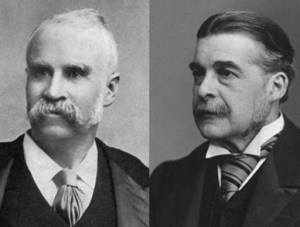
I want Gilbert and Sullivan played at my funeral.
I’ll just let that sentence sit there, while you run through 13-and-a-bit1 operettas.
You almost win – but not quite – if you’ve picked ‘Is Life a Boon?’ from Yeomen of the Guard. The problem is that it needs a very good tenor, and out of context it needs an even better tenor and I doubt whether I, or my estate, of course, by that time, can afford Juan Diego Flórez or whoever the top tenor is at the time just for a one-off two-minute gig in Sydney.
But there’s another choice, from The Gondoliers, unexpectedly. We’re still in Act 1 and the plot is only just starting to thicken. The Grand Inquisitor is pontificating to the Duke, the Duchess, Casilda and her secret boyfriend, Luiz.
Now we tend to think of The Grand Inquisitor as the Spanish Dominican Tomás de Torquemada, who spearheaded the Spanish Inquisition (so a natural person for a Spanish Duke and Duchess to visit when in Italy). As head of the Inquisition he was in charge of appeals and cases of aristocratic importance, including, presumably, hiding baby kings with friendly but drunk gondoliers. And the Duke of Plaza Toro, with his 95 quarterings on his coat of arms, is nothing if not an aristocrat and he definitely considers himself an aristocrat of importance.
Torquemada rather supported the Inquisition’s use of torture to extract confessions and the execution by bonfire of guilty parties, but fortunately for everyone, however scared the cast pretend to be, he is not this Inquisitor: the real Inquisitor of 1750, the year in which The Gondoliers is set, was the Bishop of Teruel, one Francisco Pérez de Prado y Cuesta, appointed in 1746. There’s an engraving, showing a rather elegant, ascetic-looking chap, which may or may not be based on a contemporary portrait.2
Gilbert’s Grand Inquisitor is nothing if not sententious. So, after explaining, not very usefully, to the ducal party that ascertaining the identity of the lost King of Barataria is rather complicated he announces in his best bass voice that Death is the only true unraveller. And that’s the cue for one of the most beautiful and philosophical numbers Gilbert and Sullivan ever wrote, and it’s completely irrelevant to the plot.
Try we lifelong we can never
Straighten out life’s tangled skein,
Why should we, in vain endeavour,
Guess and guess and guess again?
…
Wherefore waste our elocution
On impossible solution?
Life’s a pleasant institution,
Let us take it as it comes,
Let us take it as it comes!
Set aside the dull enigma,
We shall guess it all too soon;
…
Life’s perhaps the only riddle
That we shrink from giving up!
So there you have it – a Gilbert and Sullivan number suitable for a funeral. All right, OK, maybe for the wake down the pub.
Listen to Haddon Hall in Saturday Matinee at 2:30 pm on 14 March, part of an ongoing occasional series by Angela Cockburn devoted to operettas composed by Arthur Sullivan and think about which one you’d choose for a song relevant to an occasion.