
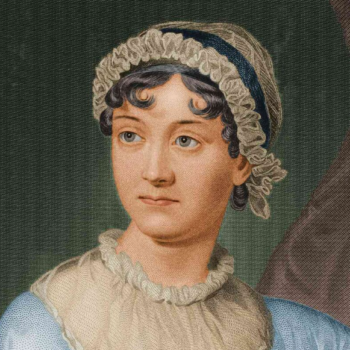
It is a truth not universally acknowledged that Jane Austen was an accomplished amateur pianist. Or so we may conclude from a number of clues this shy, sharp-eyed and self-contained woman has left us. Accomplished, but probably not gifted – her creative pen ran in other directions. The Austen family owned a ‘pianoforté’, as Jane spelt it, upon which she practised daily before breakfast in a small room so as not to disturb the household. She certainly took lessons from a Music Master, but it is unlikely that she played for any but her family and friends.
The Clementi square piano in the Austen house at Chawton is similar to the instrument she owned. In her later years, when she moved from Steventon, she wrote to her sister Cassandra:
Yes, yes, we will have a Pianoforte, as good a one as can be got for 30 Guineas – & I will practise country dances, that we may have some amusement for our nephews & nieces, when we have the pleasure of their company.
In 1790 Jane was 15 years old and already at work at her literary craft. Mozart was alive and composing, Beethoven was 20 and beginning to cause a stir as a virtuoso. Haydn was in service at Esterházy, ‘a Hireling’, as Jane described local musicians in one of her letters. Salieri, Piccini, Cimarosa and Clementi were all at their peak. None of them is mentioned by Austen.
In all her six novels, in which music drifts in and out of the scene as though played in an adjacent room, she names just one composer, Johann Baptist Cramer. But that is part of the plot of Emma, in which a Broadwood square piano arrives, a gift from an anonymous benefactor, accompanied by some scores which help to identify the donor – wrongly as it turns out.
A distant world
The elision of particulars is High Art. Specifics drag a text from the sublime to the mundane, and Jane Austen’s world is a locus sublimely distant from hum-drum reality: one reason for her lasting popularity.
There may be some difficulty fully imagining Jane Austen’s sphere, both the fictional and the real; we tend to gaze through the lens of the Victorian era. But Austen and her characters were well-to-do Georgians, and of the Regency: self-satisfied people of limited vision and small concerns. The sensibilities of the Georgian age – the politesse, the ceremony, the leisure, in fact the preoccupations of the landed gentry – were in distinct contrast to the Victorian rage for progress and industry.
That later age gave rise to a class of people who learned their manners from a Manual of Etiquette, who solemnly studied culture en masse in concert halls and art galleries. Victorian daughters learned music for similar matrimonial reasons as did Jane Austen’s young ladies. The Victorian parlour piano was a status symbol of upward mobility, but just what was played was the cause of considerable snobbery. We may recall the scene in Richardson’s The Getting of Wisdom in which Laura Tweedle Rambotham commits a social blunder by playing Thalberg instead of Schubert at a school recital.
In the autobiographical Lark Rise to Candleford Cousin Dorcas, born and raised in Regency times, shows an exquisitely mended silk stocking to young Laura, a child of the late Victorian age.
It was not thought proper then to do ordinary sewing before men, except men’s shirts, of course; never our own underclothes, or anything of that kind; and as to reading, that would have been thought a waste of time; and one must not sit idle, that would have been setting a bad example; but cutting holes in a stocking foot and darning them up again was considered industrious. Be glad you weren’t born in those days.
Cousin Dorcas was a tradesman’s daughter. How much more circumscribed were Jane Austen’s young ladies. Sewing stockings indeed! Yet Jane was admired for her fine needlework; not a few have drawn parallels between this accomplishment and her fine literary handiwork. Needlework is mentioned 15 times in Mansfield Park. Like music, it is an indication of character: attainment instead of indolence. And on a small, personal scale.
Manners makyth Jane
Our difficulty extends also to the idea of music being merely decorative; a polite accomplishment for young ladies, to divert but not dominate a gathering; a means to attract a husband. Mr Darcy ‘stationed himself so as to command a full view of the fair performer’s countenance’. Jane Fairfax and Frank Churchill’s emotion-charged encounter centres on a piano; her rival, Emma, performs with less skill but more personal allure. Lady Susan Vernon has decided notions on the subject when it comes to her ‘stupid’ daughter Frederica:
I want her to play & sing with some portion of Taste & a good deal of assurance, as she has my hand & arm, & a tolerable voice. I was so much indulged in my infant years that I was never obliged to attend to anything, & consequently am without the accomplishments which are now necessary to finish a pretty Woman. Not that I am an advocate for the prevailing fashion of acquiring a perfect knowledge of all Languages, Arts, & Sciences. It is throwing time away; to be Mistress of French, Italian, & German, Music, Singing, Drawing, &c. will gain a Woman some applause, but will not add one Lover to her list.
Lord Chesterfield similarly forbade his son to play any music at all: ‘It takes up a great deal of time, which might be much better employed.’
The Romantic era, with its nocturnes and impromptus and passionate sonatas, was yet to arrive. Such raw emotion would have affronted the ladies and gentlemen, both real and imaginary, of Austen’s time. The problem was not merely the violent thoughts expressed – the alarming modulations, the melodic daring, the roaring fortissimos – but the flagrant exhibitionism, a disconcerting breach of etiquette. Goethe’s Sorrows of Young Werther, published in 1774, set the Romantic scene. In 1810 E T A Hoffman made of Beethoven the archetypical suffering artist, spawning a generation of anguished bourgeois youth in arrested adolescence and countless outbursts of emotion on the page and upon the drawing-room keys.
Repertoire
So, what did Jane Austen and her people play? The answer is revealed in the music books belonging to Jane and her family, available for viewing both in the Chawton Museum and online. They reveal another accomplishment for young ladies of Jane’s persuasion: penmanship. Musical scores were expensive and were often borrowed and copied for domestic use. These scores provide us with a double delight. We can examine Jane’s exquisite ‘hand’ and gain a sense of her exact and delicate spirit. We can also learn what she and others of her circle played and, by extension, about the people who exist only her writings.
The pieces are mostly songs, lighter in mood than Victorian drawing-room ballads. Many of them come from popular operas. The keyboard works are often ‘lessons’, exercises to develop technique without being tiresome; and dances – even some waltzes. The closeness of waltzing couples was considered indecent, suitable only for the peasantry. Jane’s fictive people danced as a group in ‘sets’ such as quadrilles, as formal, constrained and courtly as a royal procession. But members of her younger circle were, we suspect, more daring.
The composers and works cited in her manuscripts are largely forgotten: Piccini, the Overture to La buona figliuoa; William Shield’s ‘Sweet Transports’ from Rosina – perhaps Elizabeth Barret sang it while Mr Darcy gazed at her countenance. And the ‘Marseillaise’? Well, Jane Austen had Stuart sympathies and the war of the French against the Austrians was the news of the day.
Here is J C ‘London’ Bach’s ‘Piano Concerto in D’, or rather an excerpt from that work, his variations on ‘God Save the King’; ‘Scottish’ songs set by Joseph Haydn, but nothing that might have stirred Sir Walter Scott to prose, and a ‘Duet in C’ by Tommaso Giordani, just the ticket for a couple of eligible sisters or cousins to play and attract a pair of gentleman to sit nearby and admire.
Jane’s people
‘We were talking of music, madam,’ said he, when no longer able to avoid a reply.
‘Of music! Then pray speak aloud. It is of all subjects my delight. I must have my share in the conversation, if you are speaking of music. There are few people in England, I suppose, who have more true enjoyment of music than myself, or a better natural taste. If I had ever learnt, I should have been a great proficient. And so would Anne, if her health had allowed her to apply. I am confident that she would have performed delightfully […] I often tell young ladies, that no excellence in music is to be acquired without constant practice. I have told Miss Bennet several times, that she will never play really well, unless she practises more; and though Mrs. Collins has no instrument, she is very welcome, as I have often told her, to come to Rosings every day, and play on the pianoforte in Mrs. Jenkinson’s room. She would be in nobody’s way, you know, in that part of the house.’
A further scene from Pride and Prejudice encapsulates the place of music in that world. Elizabeth Bennet is persuaded to sing, accompanying herself.
Her performance was pleasing, though by no means capital. After a song or two, and before she could reply to the entreaties of several that she would sing again, she was eagerly succeeded at the instrument by her sister Mary, who having, in consequence of being the only plain one in the family, worked hard for knowledge and accomplishments, was always impatient for display.
Mary had neither genius nor taste; and though vanity had given her application, it had given her likewise a pedantic air and conceited manner, which would have injured a higher degree of excellence than she had reached. Elizabeth, easy and unaffected, had been listened to with much more pleasure, though not playing half so well; and Mary, at the end of a long concerto, was glad to purchase praise and gratitude by Scotch and Irish airs, at the request of her younger sisters, who with some of the Lucases, and two or three officers, joined eagerly in dancing at one end of the room.
Mary plays a ‘concerto’ to compensate for her lack of allure. Elizabeth, whatever her protests beforehand, sings only to oblige.
Plus ça change
Are people like those Jane Austen observed, and from whom she crafted her fictional folk, still among us?
The Official Sloane Ranger’s Handbook, published in 1982, was a tongue-in-cheek ‘guide’ for Britain’s upper-middles, affirming ‘What Really Matters’. The reader will search its pages in vain for any mention of music-making as either hobby or profession, or, for that matter, much to do with the arts beyond repairing fine china as a suitable occupation for young Sloane women before marriage. Glyndebourne is part of the Sloane ‘season’, like Ascot and The Derby, but rather less for opera than for champers, chatter and a picnic hamper on the lawn.
One must amuse. To a Sloane, talking is the art. Music and architecture might be there too – a long way behind it. You have all been taught to speak elegantly, and you are punctilious about it, listening keenly to other people, scorning the second-rate, coming in on the beat, trying to be ‘on form’ for the evening like a great jazz musician. You Sing For Your Supper. What thrills a Sloane? Two things. A great horse on top of his form. An amusing Sloane on top of his form. It’s a pity the art is ephemeral.
Innocent diversion
Jane Austen herself was no admirer of the concert hall. Among her letters we find her mention such an occasion, of which she says merely that she ‘wore her crape sleeves … had them put in on the occasion’. Of an outdoor concert, she writes, ‘the gardens are large enough for me get pretty well beyond the reach of its sound’. She found Thomas Arne’s Artaxerxes ‘tiresome’, adding ‘being what nature made me in that article’. Nature made her immune to fine music? Or merely to grand opera?
In other words, for Jane Austen and her people, real and imagined, music was a personal, intimate matter, as exclusive as a private conversation among a select few. One must amuse. And be amused. But not possessed.
‘I consider music as a very innocent diversion, and perfectly compatible with the profession of a clergyman,’ says Mr Collins. Jane is gently mocking; Lady Susan’s disapproval of female education is raillery in the same vein.
Coda
In a letter written in November 1814 to her niece, Fanny Knight, Jane writes starchily of another niece, recently married:
I was rather sorry to hear that she is to have an instrument; it seems throwing money away. They will wish the twenty-four guineas in the shape of sheets and towels six months hence; and as to her playing, it never can be anything.
So much, perhaps, for Jane Austen and music? Mayhap her last word, in literature as in music, is ‘Do it with sense and sensibility, or do it not at all.’
By Stephen Gard
Listen on demand Sunday Special: Jane Austen and Music broadcasted on Sunday 14 December.