
By David Edmonds
Introduction
This is the first of a series of articles describing the history, activities and repertoire of the World Record Club Australia (WRC) from its commencement in Australia in 1957 through to 1976. Its commencement coincided with the early LP era. WRC was a subscription based organisation, featuring classical and other genre LPs delivered by mail or for personal collection in the capital cities.
The articles are based upon my 65 year recollection of the times, jogged by my WRC LP collection and with considerable help from various websites.
This immediate article describes the overall LP supply chain in this period and the context of WRC. Subsequent articles will focus on WRC and will describe the many recorded sound genres and notable LPs within each genre.
Unlike today, live and recorded classical music was supported then by people of all ages. This is illustrated by the sold out SSO Youth Concerts of the period, limited to attendees under 26 years old. Sales of classical LPs were popular to the younger generations.
Recorded sound timelines
A listing of recorded sound achievements and their dates follows. The initial years of WRC operations coincided with two pivotal moments, the commencement of widespread distribution of LPs and, not long afterwards, the introduction of stereo LPs.
The historical timeline of major developments and advances in making and playing recorded music is:
- 1878 – First acoustic recording – scroll format (Edison).
- 1887- flat disc format (Berliner).
- 1925- Introduction of electric recording, source direct to disc. (shellac 78 rpm). (The Gramophone Company).
- Late 1940s – Introduction of tape for source recording.
- 1948 –Introduction of vinyl LPs (45 & 33 rpm)/phasing out of 78s by about 1960, initially replaced by monaural (mono) LPs. (Columbia Records Inc. (US)).
- 1952 – Introduction of commercial LPs
- 1958 – Introduction of stereo commercial LPs (Pye). Mono LPs continued to be issued as an alternative but phased out over about 10 years.
- 1962 – Introduction of cassette tapes (Philips).
1969 – Introduction of (short lived) digital LPs.
- 1971 – Introduction of digital recording (Denon).
- 1982 – Introduction of Compact Discs/phasing out of LPs and cassettes (Sony/Philips).
- 2008 – Introduction of generally available direct downloads (Spotify).
- Early 2020s – Re-introduction of generally available vinyl.
The LP era
Size and Speeds
The first LP era can be broadly described as being between 1952 and early 1990s. As with 78 rpm, LPs were issued as 10 inch and 12 inch diameter, playing at 33 rpm. Playing times were typically up to 15 minutes and 25 minutes pers side respectively. Extended play (EP) 7 inch vinyl, both 45 and 33 rpm, were also issued at this time, the former extensively being used for pop music. 7 inch/33 rpm was popular for single classical pieces such as the Moonlight Sonata or 1812 overture.
78s were phased out by the end of the 1950s.
A disadvantage of some LPs was the issue of turnover breaks in (say) the slow movements of the Beethoven 3 or 9 or Berlioz Symphony Fantastique. These issues were never universally resolved. The 9th symphony may have been issued as 3 sides for good sound. To my knowledge the Eroica and Symphony Fantastique were never issued on more than 2 sides. Occasionally the slow movement was able to be accommodated on Side 1 but cut at an unsatisfactory sound level.
Mono and Stereo
As a generalisation, US majors, RCA, Mercury and CBS began recording and distributing stereo LPs before their major British counterparts, Decca and later EMI (Columbia, HMV, Paramount) and European counterparts, Deutsche Grammophon Gesellschaft (D.G.G, later to become DG) and Philips. Sessions could be separate for mono and stereo, months apart or else recoded on separate equipment for transfer to the respective medium.
Especially in the late 50s, the mono version could be released months early than its stereo counterpart. This is illustrated by reviews in Gramophone at this time of any randomly chosen LP under review, continuing well into the sixties. A striking example is that of the musical My Fair Lady recorded in mono by CBS in 1956. The mono was issued with great fanfare at the time. The follow up stereo was recorded and issued by CBS in 1959 with the major cast all being the same.
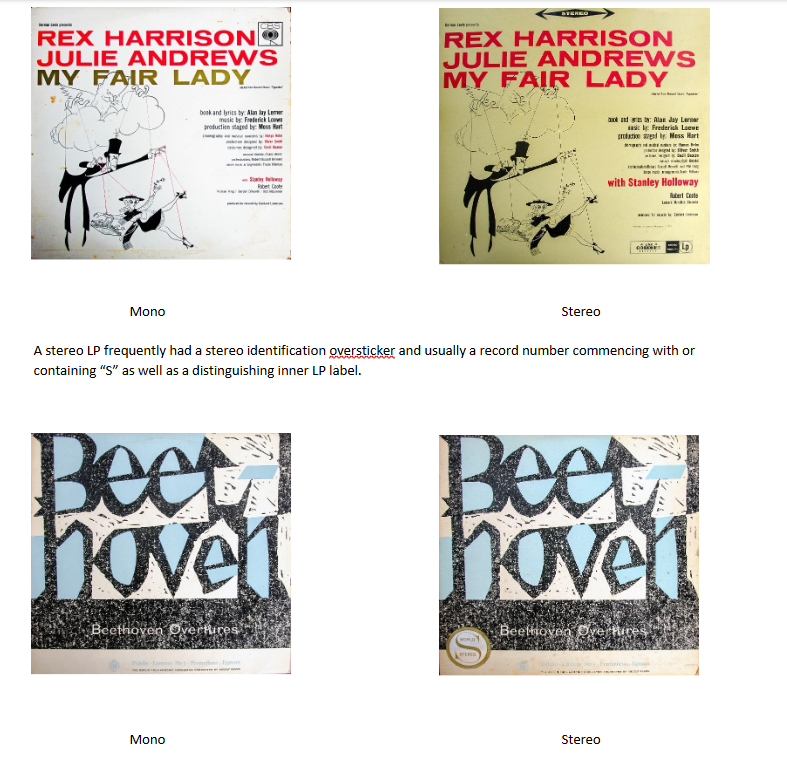
Sydney LP Retail outlets
All city department stores stocked records. The major city specialty outlets included Palings, Nicholsons (both George St), Rowe St records and Edels in various locations. Ashwoods in lower Pitt St was a very popular secondhand outlet.
Most suburban shopping centres had record stores, including Eric Andersen on the Pacific Highway at Crows Next and another (name unremembered) on the Pacific Highway at St Leonards Station. (These were the days before suburban shopping malls when there were no suburban department stores.)
For years, full price classical LPs retailed for £2/17/6 each (about $110 in today’s money). Edels and Palings held 6 monthly sales for LPs to be deleted. The cost of these was usually £1/9/6 (about $55.) Even then classical LPs were a specialty market and two record clubs provided advanced mail order services and a choice of mail delivery or pickup from a city premises. The Clubs were the World Record Club, commencing in 1957, initially as the Australian outlet for UK WRC established the previous year and the Australian Record Club, commencing in the early 1960s.
Australian Record Club
The repertoire of the larger scale and more resourced WRC will be described in following articles. Nevertheless the ARC was an important outlet of classical and popular LPs from the US CBS and Epic labels in particular. The repertoire and performances were extensive and have stood the test of time with major artists releases being reissued numerous times on CDs. Major CBS conductors included luminary musicians such as Bruno Walter/Columbia Symphony, Leonard Bernstein/NYPO. Eugene Ormandy/Philadelphia Orchestra, pianists Rudolf Serkin and Philippe Entremont and violinists Isaac Stern and Zino Francescatti. Major Epic artists included George Szell/Cleveland Orchestra, pianists Charles Rosen and Leon Fleisher and the Juilliard String quartet.
My memory is that records were by monthly mail order and priced as three LPs for the cost of two and that the sales office was at the Darlinghurst side of Liverpool St.
The next article will describe the early days of the WRC, between its early issues up to its distribution of a significant part of the EMI catalogue in the early 1960s. Further articles will describe the later years of the Club and the large number of non-classical issues over the life of the Club.
David Edmonds
References
Gramophone Magazine
Gramophone The First 75 Years Anthony Pollard
Since Records began EMI The first 100 years Peter Martland
State of the Art Deutsche Grammophon The Story Rémy Louis, Thierry Soveaux, Olivier Boruchowitch
Wikipedia and other websites
History of WRC
World Record Club UK and Australia
Please click HERE to read part 2,3,4 and 5