
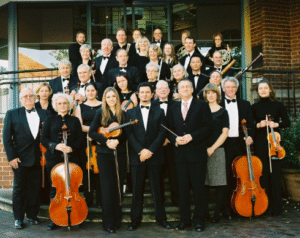
Composed between 1804 and 1808, Beethoven’s famous 5th Symphony was trying to move away from the classical style of composers like Mozart and Haydn, and was seeking to develop a more personal and dramatic musical language. By the time he composed it, he was almost completely deaf, which deeply affected his life and his work. His hearing loss is thought to have intensified his determination to create music that was both ground-breaking and emotionally powerful. It is, as the renowned Viennese critic of the time, ETA Hoffman declared, “one of the most important works of the time.” Over time it has become recognised as one of the greatest symphonies ever written. It is, therefore, a brave orchestra that progammes it, and we have to salute the Mosman Symphony Orchestra under its conductor, Andrew Del Riccio for presenting it at the end of November.
The concert, given over the last weekend of November in the Mosman Art Gallery, began with the work of a Mosman local, Dulcie Holland, who died in 2000. Her Festival Flourish was presented with the flourish one would expect, though the five cellists had to work against the 15 violinists.
The main work in the first half was the Piano Concerto No 1 by contemporary Australian composer Michael Dooley. Played by professional concert pianist Andrew Rumsey, it quickly became clear that we were listening to a symphony, not a concerto. In the typical concerto, the soloist typically plays a prominent role, with the orchestra providing accompaniment and occasionally interacting with the soloist. Dooley’s concerto blends the two elements together, occasionally giving the pianist free rein to execute Henry Litolff-like arpeggios and crazy cross hand runs. There is very little of the beautiful solo theme that runs through this piece that isn’t interrupted quickly by the orchestra. That said, it is a magnificent piece of composition, but one which I suspect many pianists will shy away from. It was interesting that during the interval a member of the audience came up to me and asked me what the difference between a symphony and a concerto was. She’d spotted the difference.
So to the Beethoven in the last half. The famous four-note motif that opens the first movement was addressed with gusto. What follows was less successful. I’ve remarked this before with his orchestra, more attention needs to be paid to the bowing. When the orchestra is playing at full-pelt many errors can be overlooked, but whenever quiet string sections are called for then the orchestra sounds thin. Thankfully the ever reliable cello section gave us the opening to the second movement that I’m sure Beethoven would have wished. The 3rd and 4th movements are played as one, they began strongly but then died a little in the middle.
I have to highly commend this orchestra, as I said at the beginning, for attacking this work and the Mosman Symphony Orchestra is one that deserves a following. There’s work to be done but bearing in mind you’re not at the SSO or their prices, I doubt whether you would be very disappointed with any of their concerts. Look them up at [email protected].
By Michael Morton-Evans