
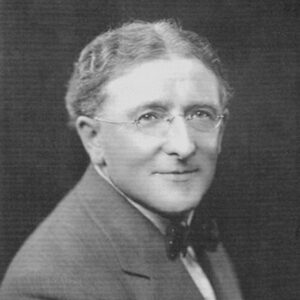
The headline isn’t mine; it was placed over the column in England’s Daily Express that announced composer Albert Ketèlbey’s death in 1959. Was it fair? Not if you accept King George V as a music critic, for Ketèlbey was his favourite composer. But then the modern branch of the Hapsburgs can lay no great claim to music appreciation. This August marks the 150th anniversary of Ketèlbey’s birth, so now is as good a time as any to assess his work.
True, he was, as a boy, a latter-day Mozart, producing a piano sonata at the age of 11 which was highly praised by Sir Edward Elgar. He went on at 12 to win a scholarship to the Trinity School of Music, the runner-up being none other than Gustav Holst. He wrote cantatas, oratorios, symphonies and chamber music, but, like another great British composer before him, Sir Arthur Sullivan, he would be known forever for the handful of tunes that have been tinkled out on parlour pianos for several generations.
Albert William Ketèlbey was a master of light music and his romantic musical notions of the music of Persia, Egypt, China and Japan would forever take precedence over the ‘serious’ stuff. An admiring fan, it is said, rushed up to him one day, saying gushingly, ‘Oh, Mr Ketèlbey, I know all your six pieces.’ ‘Six’ came the riposte, ‘more like 600.’
When the Trinity scholarship came to an end the examiners were so impressed he was offered a position as a professor and examiner at Trinity. There was one stipulation – because he looked so young he had to wear a tailcoat when in the building. The college’s secretary lent him £5 so he could accept the offer and buy the tailcoat.
A restless soul, Albert spent some time as a church organist. Tiring of that he became musical director of a West End variety theatre in London and eventually Music Director of the famous music publishing company, Chappell & Co. Finding no market for his more serious compositions, he tried an experiment. He took the ‘second subjects’ of these works and fashioned separate pieces from them. In this way, for example, ‘In a monastery garden’ was born and did service at a seaside end-of-pier resort, the slow movement from a string quartet making an admirable background for a river scene in a music hall sketch. ‘It’s a bit higher brow than we’re used to,’ the director told him. ‘You should try and write some serious music!’
A visit to Chilworth Friary, near Guildford in Southern England, provided the idea for ‘In a monastery garden’. The tune from the string quartet now suggested, so the synopsis said, ‘a poet’s reverie amidst beatific surroundings’. Various deft touches were added to indicate ‘birds singing, monks chanting, the organ playing and the chapel bell tolling’. The world fame, which came to him at the age of 50, amazed him. The piece was constantly requested by war-battered soldiers in military hospitals and the king, arriving late for a concert at which it was the opening work, was so cross to have missed it that he insisted the orchestra play it again at the end.
The name Ketèlbey was known throughout the British Isles and far beyond. In much the same way as many are often fooled by the name Gustav Holst, believing him to be Scandinavian rather than English, so, too, has the name Ketèlbey confused many people. There was a legend that his real name was A William Aston, but in truth Aston was but one of several pseudonyms under which he published his work. He also used André de Basque, Dennis Charlton, Raoul Clifford, Geoffrey Kaye and Anton Vodorinski.
His biographer, John Sant, discovered that the original family name was Kettleby, but Albert’s father George changed it to Ketelbey, disliking the notion that the water-boiling receptacle should be the emphasis for the pronunciation of the name. (As an aside, it’s of interest that Albert’s brother Harold, a violinist, emigrated to Australia and descendants of his family still live in New South Wales.)
Keen classical music lovers will attest that Ketèlbey’s serious compositions are, on the whole, of good quality, it they hadn’t been he would never have beaten Holst for that scholarship. Perhaps we can put him in the same bracket as his British contemporary Eric Coates, or the American Leroy Anderson, all writers of first-class classical compositions, but tarred with that unfair light-music brush.
One thing is certain, however, Ketèlbey was the first British composer to make a million from his compositions. By the 1920s a million copies of ‘In a monastery garden’, with a romantic picture on the cover, were to be found on the music desks of pianos throughout the world.
‘In a Persian market’, ‘Sanctuary of the heart’ and ‘Bells across the meadow’ became equally popular and were recorded in every possible arrangement. By middle age he had, as he himself put it, acquired ‘fame and fortune in a monastery garden’. He enjoyed travelling and, with his natural gift for languages, was able to converse with artists and audiences abroad and was frequently asked to conduct such famous orchestras as the Concertgebouw of Amsterdam.
His ability to write melodies of instant appeal was generally acknowledged, but not everybody realised that his skill in orchestration developed through years of practical experience – he could play numerous instruments, the cello being his favourite.
The winter of 1946-1947 in England was a shocker. Ketèlbey’s home was flooded when a water main burst one night. He and his wife, now both in their 70s, became seriously ill after trying to salvage his valuable library of books and scores. She died and, for a while, he suffered a breakdown.
After a period of living in hotels, to which he was ill suited, he married a woman from the Isle of Wight, where he finally settled. And there he died in 1959 at the age of 84. As his coffin passed behind the curtains of the crematorium it’s not hard to guess which piece of music was played. Strangely, his death was hardly mentioned in the press, even though he was one of England’s most prolific and popular composers.
-Michael Morton-Evans