
True Romantics
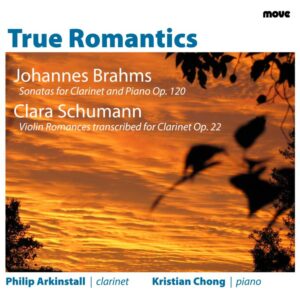
Johannes Brahms Sonatas for clarinet and piano, Op.120
Clara Schumann, 3 vlion Romances(transcribed for clarinet), Op.22
Philip Arkinstall, clainet
Kristian Chong, piano
MOVE MCD 668
★★★★★
Johannes Brahms was particularly fond of the German clarinettist Richard Mühlfeld for whom the two sonatas that make up Opus 120 were written. But when you listen to the Allegro appassionato that begins the Sonata No 1 in F minor, you can’t but help thinking that he had Clara Schumann in mind when he wrote it. The movement makes full use of the clarinet’s higher register, develops into a small tempest and eventually winds down to a tenderly expressive coda. The following Andante sustains the sweetly reflective mood. It’s a little 22 minute love letter. The second sonata in E flat follows much the same patterns except that the allegro appassionato comes this time in the second movement.
Clara Schumann wrote her three Romances, Opus 22 initially for the great violinist Joseph Joachim, but they’ve been transcribed for this recording for clarinet, surprisingly by the Australian violinist Roger Young. Do they work? They are beautifully played by Philip Arkinstall, but personally I think they are better fitted for the violin. By way of contrast, Brahms transcribed his two clarinet sonatas for viola, but they work much better on the clarinet. In Schumann’s case Romances really have nothing to do with romance. It was a term used in those days to commonly refer to any short piece of music for a single instrument, usually a piano, or another instrument with piano accompaniment. Of the three short Romances, the second Allegretto is the most engaging, it soars and swoops, melancholy giving way to joy. Here the piano gets to play a bigger part and the exchange between the two instruments is wonderfully playful. Schumann marked the work to be played mit zartem Vortrage, with delicacy, and Arkinstall and Chong abide perfectly by her instruction.
All in all, this is a delightful CD. Arkinstall and Chong clearly have an excellent rapport, and this will make a first-rate addition to anyone’s musical library.
Michael Morton-Evans