
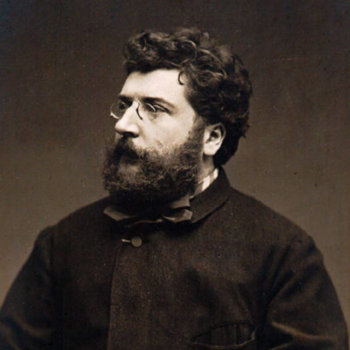
The French composer Georges Bizet was born in Paris in 1838, living most of his life on the southern slopes of Montmartre before dying just 36 years later, on 3 June 1875. He became a highly accomplished pianist, and also wrote orchestral music, piano pieces and almost 50 songs and various choral and incidental works, including music for the ballet L’Arlèsienne. But for all practical purposes his career may be seen as beginning and ending with opera.
Georges was an only child, his father a hairdresser turned singing teacher with a few compositions to his name, and his mother a talented pianist who also came from a musical family. Georges’ introduction to music started when he was only four. When he was nine, having learnt all his parents could teach him, his father sought to procure his early admission to the Conservatoire. His talent was quickly recognised but, since the regular classes were already full, he began by studying the piano with Antoine Marmontel before being formally admitted, in 1849, just before his 11th birthday.
He stayed at the Conservatoire till 1857. His teachers included Pierre Zimmerman, his future father-in-law Fromental Halévy and Charles Gounod, who took a great liking to him, arranging many of his works, thus allowing him to earn some money. He won numerous prizes, culminating, on his second attempt in 1857, in the coveted Prix de Rome, which enabled him to spend almost three years in Italy. These turned out to be the happiest years of his life. He was free of financial worries, took periodic holidays in the country, made friends easily despite being rather quick-tempered and started on or planned many new works.
Bizet’s earliest compositions date from just before he turned 12. His first published works were two songs that appeared in 1854 but made very little impression at the time. A number of other student works date from this period, including his first dramatic composition, a one-act comic opera, La maison du docteur, seemingly intended only for private performance and with only the vocal score surviving. These were followed by his first significant orchestral works: an Overture in A and, in 1855, his finely crafted Symphony in C, nowadays familiar, although unperformed until 1935.
Written in the interval between his two attempts at the Prix de Rome, the first of Bizet’s operas to be staged publicly was Le Docteur Miracle. The winning entry in a competition promoted by Jacques Offenbach, with the intention of raising the status of operetta, it premiered at the Théâtre des Bouffes-Parisiens in April 1857, launching his career as an opera composer, although more than six years would elapse before another of his works reached the stage.
This was the comic opera Les pêcheurs de perles (The Pearl Fishers), which premiered at the Théâtre-Lyrique in September 1863. The result of a commission after he won the Prix de Rome, it ran for 18 performances and was tolerably well received by the public, although press reactions were generally hostile and dismissive, the more malicious critics accusing him of imitating Wagner, Verdi and, of all people, Felicien David. Despite the music being rather uneven and at times unoriginal, it has been staged quite regularly since the 1880s.
The Bizet catalogue lists 27 operatic works, although only 11 remain extant, the others being merely projected, substantially incomplete, lost or destroyed. All but two of those that survive were staged intermittently up to 1885, the other two were first performed only in the 20th century. Only a few remain in the repertoire today.
Apart from the modestly favourable reception of The Pearl Fishers, none of the others initially achieved much by way of success in Paris, although from the outset they were deemed sufficiently original to be taken seriously, including by Hector Berlioz and a few of Bizet’s contemporaries.
It was only posthumously, though, that he at last achieved public recognition following the success of Carmen, his final work. First performed at the Opéra-Comique on 3 March 1875, its flaunting of convention shocked and scandalised the first audiences and many of the critics, although some of the more even-handed ones praised individual pieces, while still mostly predicting that the work would not attract the public.
After suffering two heart attacks in quick succession Bizet died exactly three months later, on the sixth anniversary of his unhappy and stressful marriage and the 33rd performance of his opera. Sadly, he would never know that Carmen would become the most popular and frequently performed work in the entire operatic repertoire. For the unfortunate composer this fame came too late.
To celebrate the 150th anniversary of Bizet’s death, 2MBS will present a series of programmes in June and early July, including his three best-known operas: The Pearl Fishers at 8pm on Wednesday 4 June, Carmen on Wednesday 25 June and The Fair Maid of Perth on Wednesday 2 July on demand or live in the program At The Opera.
– Rex Burgess